Ace of Spades BlongerBros.com
       Belonger Genealogy * True History * The Blonger Gang * Sam's Posse       

Van Cise Project
Van Cise Campaign
More Info

True History of the Famous Blonger Bros.

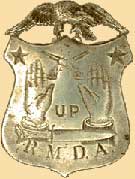
Rocky Mountain Detective Association badge

Evening Review
Commentary by Craig and Scott Johnson

6/15/2009

Mollie Blonger

Molly/Mollie is an Irish variant of the name Mary. The Blongers were half Irish on their mother's side.

According to thinkbabynames.com:

It is of Irish origin. Pet form of Mary (Latin) "star of the sea". In use since the late Middle Ages. In the past, "moll" had meant a prostitute or a gangster's girlfriend, making the use of this name uncommon.

So what's Mollie's deal? Here's what we know:

In 1885, census records indicate Mollie Blonger was in Dodge City — as was Sam, according to testimony in a case before the Supreme Court.

In April of 1888, three days after former Albuquerque prostitute Kitty Blonger was acquitted of murder, Mollie Blonger is arrested in Albuquerque for "maintaining a nuisance."

And now we find that in 1889 "Miss Mollie Blonger" has an unclaimed letter at the Denver PO. By this time, Sam has been calling Colorado home for a few years now, and Lou has come to Denver from southern NM to settle in for the long haul.

If that's all we know, what what else can we surmise?

First, the Albuquerque connection.

Since, 1) in 1882, Lou's "woman" was noted as running an Albuquerque house of ill-repute, and 2) "L. Blonger" showed up for Kitty Blonger's trial in Arizona in 1888, and 3) Kitty was noted at the time of her trial as having formerly lived in Albuquerque, we assume Kitty was hooking in that town in 1882 while the Blongers were there.

Since Mollie was doing the same in Albuquerque in 1888, it seems reasonable, therefore, to wonder if she was also part of the Blonger stable in 1882.

Now what about Mary Blonger?

No death certificate is listed in any of the online indexes, but a Rootsweb posting for Fairmount Cemetery in Denver (1890-1906) lists Mary M. Blonger, age 34, buried on April 22, 1893. Mary — Molley.

Then there's the Marvin connection.

An online index lists the marriage of Marian Blonger and Molley Ann Beard in Lincoln County, Missouri (north of St. Louis), on August 7, 1873. As Marian is not a man's name, it is reasonable to assume the name might in fact be the youngest of the Blonger brothers, Marvin. He would have been 22 at the time.

Marvin is known to have come to Leadville by 1883. He moved on to Montana by 1891, where he spent many years in the mining business.

According to an online index of California deaths, the the mother's maiden name of Marvin's daughters Abbie and Ollie was given respectively as Penoyer and Penard.

Penoyer, Penard, Beard. Could the same person who mistook Marvin for Marian have also mistaken Penard for Beard? It's not much of a stretch, so we hypothesize that Marvin's wife was actually named Molley Ann Penard.

And then there's Nellie Blonger.

In the 1885 Colorado state census, we find a couple living in Arapahoe County as Edw. Blonger, 30, born in France, and Nellie Blonger, 24, born in Germany. Is "Edw." really Marvin, whose middle name was Edwin and was 34 years old? Is "Nellie" actually Molley? And who thought they were from France and Germany? Papa Blonger was French Canadian...

What's more, Nellie Blonger in 1881 is noted as one of the "young ladies" attending the 8th anniversary ball of Court Star of Leadville No. 7195, Ancient Order of Foresters of America.

If Nellie was attending a ball in 1881 as a "young lady" — this has to mean unmarried, doesn't it? The "married people" were also listed — then Blonger was her maiden name, no? Even if one assumes that Edward Blonger was from France, and not related at all to our Blongers, would his wife from Germany also be named Blonger in 1881 — presumably unmarried and going to dances unaccompanied?

What's going on here?

-CJ


The Blonger Shaft

Speaking of the Blonger Shaft...

BRIMSTONE—Leadville people are interested, not to say dismayed, to find that under them is an immense quantity of sulfur. Ore from the new strike in the Blonger shaft returns 30 per cent sulphur, along with a hundred ounces of silver to the ton. To old time natives who fail to recognize the name of Blonger it must be explained that this is the original old Pittsburg claim on Fryer hill, which in early days was regarded as the greatest silver mine in the west, containinb rich silver cloride [sic] and lead carbonate at grass roots. Now a company of lessees, who have been sinking since last March, have tapped a tremendous vein after going down 140 feet through hard lime, porphyry and shale. The deposit stands at an angle of twenty degrees. The ore is expected to average about 35 ounces silver.

-CJ


5/24/2009

World Travelers

Scott found a new article indicating Sam and wife Virginia traveled to Algiers in February of 1903, sailing out of Havana. Bon Voyage!


Lottie Deno

Picked up a copy of Jan Devereaux's brand new book the other day, Pistols, Petticoats & Poker, The Real Lottie Deno: No Lies or Alibis (High-Lonesome Books). A great read. Lottie — Carlotta Thompkins — was a western original indeed, a lady of the evening, and high-stakes gambler in her own right, having bested the likes of Doc Holliday. Some even say she was the inspiration for Gunsmoke's Miss Kitty.

Later in life, with her husband Frank Thurmond, she cultivated a reputation as a lady of the highest caliber, a pillar of society in Deming, Kingston and Silver City, New Mexico.

More to the point — and you new there would be one — Scott and I were privileged to contribute our two cents to the project. The Blonger connection was two-fold.

1. The Earp Posse connection. When things got too hot in Arizona after their infamous Vendetta ride, Wyatt, Holliday and the boys made for sanctuary in Colorado — making two notable stops along the way. First, in Silver City, where evidence suggests they dined surreptiously at Lottie's restaurant (and may even have stayed overnight with Lottie and Frank). As mentioned, Lottie was at least acquainted with Holliday, and maybe even Wyatt.

Then, after leaving Silver City, the posse stayed for more than a week in New Albuquerque, where, with Sam away on business (Colorado, coincidentally), Lou was acting marshal. Again, Lou was probably acquainted with Doc, and perhaps Wyatt. He was certainly an associate of Earp's friend Bat Masterson and others of the Dodge City/Tombstone crowd. Dodge City gambler and Masterson associate Charles Ronan served occasionally as one of Sam's deputies.

It's easy to assume (though unproven) that the posse made for both towns in the knowledge they had friends who could provide shelter and assistance.

2. Though (notoriously incomplete) census records do not bear it out, Lou indicated in his military pension file that after leaving Albuquerque, he lived with Frank Thurmond and Lottie for five years in Silver City, Kingston and Deming. Devereaux's timeline places the Thurmond's in these locations as well. It could be that Lou did some traveling during this time, but he does note two local doctors who cared for his varicose veins, which were purportedly caused by a fall during his brief service during the Civil War, and the reason for his pension request.

What's more, in Black Range Tales, local prospector McKenna notes that Lou "Blanger" was among the big gamblers at Kingston, along with the Thurmond brothers.

Devereaux makes the point that, though the Thurmonds were, by then, interested in cultivating their image as civic leaders — and they were — their apparent continued association with Lou was no feather in their collective cap...

Well, done, Jan.

And thanks for the nod to our research and this website, noted in several footnotes.

-CJ


5/23/2009

Speaking of the theatre...


-CJ


5/22/2009

Simon

A few new tidbits from the Leadville Daily Herald, courtesy of Colorado Historic Newspapers:

In the February 16, 1881 issue, we see that Taylor et al vs. Blonger et al is stricken from the trial calendar. A mystery.

In the same column, a few familiar names pop up. Along with numerous others, Bill Nuttall — of Deadwood fame (the #10 saloon where Hickok died) — had cases dismissed by the DA with leave to reinstate; keeping a saloon, and keeping a theatre. Nuttall later showed up in Albuquerque in 1882, accused of conspiring with con man Con Caddigan to con a sucker out of his last few dollars, right about the time Sam and Lou high-tailed it out of New Mexico.

T.C. Howard and Charles Laiscelles were also let of the hook for keeping a saloon and theatre. In 1879 Laiscelles was business manager of the Novelty Theatre in Georgetown. A Blonger was running the show — the smart money says it was Lou.

Novelty Theater

In March of 1881 Samuel Marco was charged by Simon with stealing powder from Leadville's Robert E. Lee mine, where Simon was superintendent.

In September of 1882, Simon led a company of society folk on a tour of the Robert E. Lee.

October 6, 1882, "The Lee mine still continues to be the great property about Leadville, and new developments are constantly being made by the mine superintendent, Mr. Simon Blonger, which add to the value and importance of the mine. Great ore bodies of exceeding richness are left standing in the already developed portions of the mine and the present policy of the management of the mine is to push forward new development work and to open up new territory."

In February of 1883, as a member of the Colorado legislature, Simon voted for a bill to tax the net output of Colorado mines. The next day, the Daily Herald said "It would perhaps be unreasonable to expect intelligent action from Costello, but better things were hoped for from Blonger."

February 13, 1883, an article from the Santa Fe New Mexican, describing the discovery of ancient tools in the Bottom Dollar Mine by "Blonger and Whalen" — Joe Blonger, that is — is quoted, noting that the Blonger mentioned is brother to Simon. The New Mexican article is, in fact, one of the very first articles we came across in our search for the Blongers.

The New Mexican, April 21, 1883

OLD SPANISH SHAFT.
Discovery of Old Workings, Stone Hammers and Chisels.
Messrs. Blonger and Whalen, who have the contract of sinking a shaft in the Bottom Dollar mine, near Cerrillos, made an interesting discovery on Monday last. While working at a depth of 110 feet they dropped into an old tunnel made by the Spaniards no less than 200 years ago and out of the debris they took a number of stone hammers, chisels and picks and found every evidence that this mine belongs to the same class of sliver producing mines as does the Mina del Tiro property, which is the most perfect Spanish mine yet discovered in this part of the country. These stone tools were left in the mine by the Pueblo Indians, and have lain there since the revolt of 1680, at which time the Indians filled up the mines with rubbish to hide them and prevent the Spaniards from discovering and working them. The owners of this mine, who are in Santa Fe, are very much gratified of this evidence of the former value of the Bottom Dollar property. Messrs. Blonger and Whalen will resume work to-day and will bring these old chisels and hammers to Santa Fe to-morrow or the day following.

It was later at the Bottom Dollar, in 1887, that Joe shot his boss, Alexander Allan — with Allan's own gun — as Allan was about to crush Silas Smith's head with a rock. Joe and Silas has expressed an interest in going to Santa Fe for a little recreation, and Allan objected. Strenuously.

On February 21 of 1883, Simon's resignation from the Robert E. Lee was accepted.

On April 27 of 1884, Simon and "Dr. Eyer" were noted as the new lessees of section 9 of the New Pittsburg claim. This raises the distinct possibilty that the so-called "Blonger Shaft" is named for Simon.

Blonger Shaft

In August of 1886, Simon is working for the Trophy Mining company.

-CJ


4/22/2009

Blonger Day

Okay, so it's not really April 22, it's the 30th. But I forgot Blonger Day this year. Unforgivable.

Blonger Day, as you'll recall, commemorates the day in 2003 that brother Scott figured out just who Uncle Lou really was. It's customary on this day to review the previous year, the new information uncovered and other news. So let's get to it.

Van Cise Project

The big news, of course, concerns the new Justice Center currently under construction in Downtown Denver. In conjunction with the Van Cise family, Denver attorney Larry Bohning, Westword reporter Alan Prendergast and a host of interested parties, we succeeded in convincing Mayor Hickenlooper to name the new detention center, in part, after Lou's arch nemesis, Col. Philip Van Cise. Presenting the Van Cise-Simonet Detention Center (It's somewhere in there).

Denver Justice Center

Here's the video we posted on Youtube to further the effort:

The still-living John Simonet has served as Denver's Director of Corrections. The Justice Center is expected to open next year.

Details on the project can be found in our section on the Van Cise Project.


Green River Whiskey

This year we also heard from Rob McCulloch, who tells us Green River Whiskey is back! Yes, the Whiskey Without a Headache, the one that Blots Out All Your Troubles, The Official Whiskey of the U.S. Naval Hospital, is back in production!

Legend has it that distiller J.W. McCulloch, one of the partners in the Forest Queen mine, bought his share from Lou for twenty barrels of the stuff.

Green River Whiskey


The Maiden Papers

Researching in Denver, brother Jeff found the papers of Robert Maiden, part of the collection at the Denver Public Library.

Maiden was working for the Federal Narcotics' Bureau in Kansas City when Van Cise recruited him to assist in the Blonger gang investigation. Maiden worked with Andy Koehn and A.B. Cooper in surveilling the gang, and the collection contains notes, newspaper articles and other items related to the case.

Maiden's Scrapbook is huge - about 22" square and 4" thick. It's mostly newspaper clippings from the Post, News and Times about the trial.

Of particular interest — we finally know Louis H. Blonger's middle name, Herbert. This item also indicates Lou was arrested in 1898, and twice in 1901, the former for assault and battery. That bears scrutiny.

Lou rap sheet

Jeff found numerous clippings from the Denver papers, and a few cartoons. This is a quote from a Rocky Mountain News front page article by Van Cise, 3/29/1923:

The American jury system has been on trial, and has stood the test. Justice may be slow; but she is sure. Lou Blonger has been a sinister influence in our political life for thirty-five years, and his men have always escaped the hands of justice. Today Denver has a new reputation among denizens of the underworld, and professional criminals will give her a wide berth. Secure in our homes and our firesides, we may now build for a real prosperity of the future.
Jeff also found numerous legal papers of various kinds, including the court stenographer's transcript of the trial, annotated with witness names in the margin and including a list of exhibits entered into evidence; a list of the fake stock exchange locations; The Detective, a newsletter, including wanted posters of Denver confidence men; a national trade journal for police officers, including the bunco gang with a request for any info about their previous criminal records, and an interesting article about the need for a federal investigative organization; a comprehensive list of all of the con men in Denver (hundreds); Van Cise's own notes including 6-7 pages from Van Cise's personal surveillance notebook; Jackie French's police record; a list of Denver top cops; Memorandum Outline of Opening Statement in Conspiracy case, a 74-page typed document, describing the charges against the gang, glossary of con terminology, an example bunk, outline of the physical evidence, etc.; a comprehensive document describing the DA's case against Blonger's gang; George Reamey's testimony against his former associates; and many photos, mug shots, surveillance notes, testimony and more.
One document even describes the gang's turf: "Their (the steerers) job was to find a sucker and in doing this they covered 17th Street from the Union Depot to Broadway; 16th Street from Daniels and Fisher's to Broadway; the Civic Center and State Capitol grounds and any other place in Denver where they thought tourists or strangers in the city might be found." The Justice Center, as it happens, is basically adjacent to the Civic Center/State Capitol area.

Finally, these poems, by Nick Carter, were published at the time of the trial.

MOTHER GOOSE
Amended
(In This Case No Apologies Are Necessary, Except to the Poor Public.)

Little Boy Lou, come blow your horn,
The sheep's near the statehouse, as sure as you're born!
Where's the little boy that looks after the sheep?
There in the courtroom fast asleep!

Hush-a-bye, bunkie on the tree top!
The evidence maketh your cradle to rock;
When the jury comes in the cradle will fall,
And down will come bunkie cradle and all!

There was a man in our town,
And he was Phil Van Cise;
He rounded up some funny men
And caught 'em by surprise,
And when he found he had 'em locked
Inside the jail-house door,
He jumped into a hotel room
And rounded up some more.

Little Bo-Bunk had lost her sheep,
And she's just mad as fury;
But that's all right, they'll come to court,
And wag their TALES to the jury!

Hey, diddle, diddle!
The bunks and Judge Riddle,
The sheep jumped over the moon.
The defendants laughed
To see such sport-
But some of 'em laughed too soon!

Simple Simon met a con man
Strolling o'er the lea;
Said Simple Simon to the con man,
"Make some dough for me."
Says the con man to our Simon,
"Show me first your money."
Says Simple Simon to the con man,
"Mercy, ain't you funny?"

Sing a song of sixpence,
A pocket full of braid;
Four-and-twenty blackbirds
Caught in a raid.
When the raid was over
They all began to sing:
"Whatcha got us in for?
We ain't done a-thing."

There was an old con man who lived in a shoe;
He had so many helpers he didn't know what to do.
He tried to catch minnows, got caught by a whale,
And he and his helpers all landed in jail.

Tuff, he was a con man; Tuff he was a thief,
Tuff, he came to Denver and stole a piece of beef.
The colonel went to Tuff's house; Tuff, he was in bed,
The colonel took the evidence and broke Tuffy's head!

The King of Bunk went up the hill,
With twenty or more men;
The King of Bunk came down the hill
And headed for the pen.

Le Journal des Con-con Hommes

According to the Maiden Papers, at some point after his arrest Lou requested the return of his personal journal from Col. Van Cise, who refused. We do not know the contents of this document, but we are told it was written in Lou's own "flowing hand," and we know its title, Le Journal des Con-con HommesThe Journal of Con-con Men.

I want very much to locate this document, and would be honored to transcribe it. From the title I would not be surprised if this turned out to be an important addition to the literature on the subject of confidence men. Lou was a party to some of the great advances made in the art and science of the American con, and judging from the title, I can imagine his journal has plenty to say on the subject.


Bonynge vs. Shafroth

In May of 2008 this turned up on GoogleBooksContested Election Case of Robert W. Bonynge vs. John F. Shafroth From The First Congressional District of Colorado, published in 1903.

The fire and police board of Denver was said to be cooperating with the state Democratic Party to influence elections — surprise. As an example, Lou was reported to have made numerous visits to the state party headquarters for the purpose of buying protection, in this case from party operative Charlie F. Wilson.

According to Wikipedia:

John Franklin Shafroth (June 9, 1854-February 20, 1922) was a United States Representative and Senator from Colorado... He moved to Denver, Colorado in 1879 and continued the practice of law. He was city attorney from 1887 to 1891 and was elected as a Republican to the Fifty-fourth Congress as a Representative. He was reelected as a Silver Republican to the Fifty-fifth, Fifty-sixth, and Fifty-seventh Congresses; he presented credentials as a Democratic Member-elect to the Fifty-eighth Congress and served from March 4, 1895, until his resignation on February 15, 1904, when he declared his conviction that his opponent, Robert W. Bonynge, had been duly elected — after which he was often referred to (sometimes admiringly, sometimes sarcastically) as "Honest John."

Furthermore, perhaps riding to some extent on the good will engendered by his unusual candor, Shafroth served as Governor of Colorado from 1908 to 1912. He's buried in Fairmount Cemetery, as is Lou.

Shafroth's willingness to allow that Bonynge was in fact the duly elected representative from Colorado's First District was apparently his response to the aforementioned suit filed by Bonynge, the text of which runs over nine hundred pages. And those pages reveal, in bits and pieces, yet another chapter in Lou Blonger's rise to power.

First let's look at what we already knew.

In late June of 1901, a British tourist named Ritter — said to be a millionaire and proprietor of the Astor house at Tien-Tsin, China — found himself in a poker game with Lou Blonger. After losing a few dollars, he dealt himself a hand that appeared to be a sure thing. Wishing to maximize his win, a man was dispatched to Ritter's quarters to fetch a bigger bankroll. When the cards hit the table, the Brit had inevitably lost $250.

Certain he had been duped, Ritter had a constable rouse a Justice Rise from his sleep, demanding Lou's arrest. What followed was a textbook example of the game Denver bunko game. Lou and several of his men were arrested, then a deal was apparently struck and Ritter got his cash back, after which he went on to China, leaving Chief Armstrong to pursue the case without him.

DA Sanborn rejected the original complaint, calling it faulty and requesting a continuance. He doubted publicly that Chief Armstrong's testimony could convict Blonger. In fact, the Chief never showed for the hearing, and when Sanborn put City Detective Delaney on the stand, his testimony lacked conviction. According to the Denver Times:

The events leading up to the card game were not introduced nor was there any attempt to have them brought in. Chief of Police Armstrong, who had loudly stated that he would be present and testify against Blonger was conspicuously absent. No mention was made of the chance meeting between Ritter and the confederates of Blonger and the admission to the room in the Good block by means of the peculiar raps on the door. Another inconsistency that remained unexplained was Blonger's arrest and the return of the money to Ritter. The whole proceeding was a studious effort to whitewash Blonger and give him a character and license to continue to prey on unsuspecting travelers.
The claims of the police department, from the president of the fire and police board down to the latest appointee to the force, that determined efforts are being made to clean the city of the preying classes are all swept away when confronted with the facts as they exist. Less than a week ago President Adams of the board gave out the statement that the county court and its forces were interfering with the police.

The charges were promptly dropped for lack of evidence.

In August of 1902, Police Magistrate Thomas was said to have received a sizable sum of money from Denver gamblers, and Governor Orman was looking into it. According to Thomas, the money was collected on behalf of a relative who "lost" the cash to associates of Lou. The Governor called on Thomas to produce the relative. According to the Denver Times:

Evidence in the possession of the fire and police board shows that "Lou" Blonger, who has been in charge of the wholesale bunco operations in this city, had a long conference on Saturday evening in the "red room" at the corner of Sixteenth and Curtis streets, and that upon leaving he told a friend he had the matter fixed up so that his bunco game might resume operations, with not a pretense of prosecution by the police department. Indications are now that the police department will tell all it knows of the grafting operations carried on, and that thereby the danger of an investigation of the police department will be averted.

Then came the 1902 elections.

Elbert County Banner, Nov. 14, 1902

SPICY NOTES FROM GEORGE'S WEEKLY.

[Selected excerpts from that column]

Apparently a lot of evidence is being collected in Denver for the prosecution of the ballot-box stuffers of that city. But nobody believes that any one will suffer for the crimes they committed in this line except the poor widow who was made a dupe of by scheming politicians, and who admits that she voted oftener than the law allows.

Throw out Arapahoe county and make it unaimous [sic]. It is rotten to the core. The gamblers and bunco steerers were too raw, as Jack Hall's dirty work amply indicates. Throw out this county—decency demands it.

Talk about Republican outrages against the ballot-box! Ye Gods! In the palmiest days of Brady and Connors (and they were the limit in their day) they weren't a circumstance to Jack Hall and the police force. At Eighteenth and Arapahoe streets on election day we saw repeaters marched up to the polls under the protection of policemen in uniform while Chief Armstrong and Smithwick stood complacently looking on.

When Stimson was nominated we declared openly that it "appeared like a walkover for Stimson." During the past three weeks, however, our readers have noticed we predicted the election of Peabody. Not many of our friends believed it possible, but when we saw the rawness and the ignorance displayed by the Democratic leaders in winking at the dirty work of the Blongers, the Halls and the other criminals, we felt such decent Democrats would revolt, and they did with a vengeance. Then too, every decent Republican got hot and went to the polls to record their protests. Thousands of decent people voted Tuesday who have not voted in years.

Jack Hall voted fourteen men four times each at one polling place last Tuesday, we are told. This certainly makes the record for "efficient work." Jack deserves hanging for his splendid work. We believe everybody who is entitled to vote ought to be permitted to vote once and have the vote counted. People who sell their votes or repeat ought to be taken out quietly and strung up.

Peabody voted for Stimson and the latter returned the graceful compliment. "Brooks voted for Adams," says the Post, "and Adams went to the polls and voted for himself."

Noting that Representative Shafroth goes unmentioned here, the article above nevertheless begins to scratch the surface of the Bonynge vs. Shafroth controversy and that filthy little election of 1902.

The final tally in this election had Shafroth winning over Bonynge by over three thousand votes. Bonynge contended that he won by at least five thousand votes, and his lawyers had a lot to say on the matter. Here's a morsel from the 390 page document.

The contestee, John F. Shafroth, by reason of the grossest election frauds, feloniously devised and consummated by the political managers and election officials belonging to the Democratic party, acting for and on behalf of the contestee herein, and particularly in a circumscribed portion of the business houses, rooming houses, and tenderloin districts of the city of Denver, in said Arapahoe County, comprising mainly 28 election precincts out of the total of 236 election precincts in the said county of Arapahoe, which said election precincts contain a very small percentage of the voting population of said county; which said frauds were fraudulently [really?] and feloniously devised and consummated by political managers of the Democratic party and Democratic county officials of said Arapahoe County and the fire and police departments of the City of Denver, with the active aid, connivance and knowledge of the election officials in said various election officials in said various election precincts, for the benefit of contestee, John F. Shafroth, and other candidates upon the Democratic ticket, by means of fraudulent, fictitious, and "padded" registrations of illegal and fictitious names, by intimidation, interference and violence in preventing the registration of Republican voters; by malconduct, fraud, corruption, and oppression on the part of the policemen, election constables and officials, and judges and clerks of election, on behalf of contestee and other candidates of the Democratic party; by the "stuffing" of ballot boxes on election day with fraudulent and fictitious ballots illegally marked for contestee and the Democratic candidates; by the illegal voting of repeaters for the contestee and the Democratic candidates; by assualts, insults, violence, and intimidation practiced by the police and election constables and by the precinct election officials, resulting in the driving away of Republican voters from the polls and preventing them from voting for contestant; by violence and felonious assaults upon Republican election officials, watchers, challengers, and workers, thereby driving them away from the polls, and making it possible for said election officials to perpetrate still greater frauds against the purity of the election; by falsifying the election returns, and by innumerable other acts of intimidation, violenece, and fraud, confined mainly to said business portion, lodging houses, and "tenderloin" district of said city of Denver; all of which said fraudulent, illegal, and felonious acts resulted in more than 6,000 illegal, fictitious, and fraudulent votes being counted, returned, and canvassed as cast for contestee, John F. Shafroth...

And then it goes into some detail.

So let's take a look at Lou's part in all of this, beginning with the testimony of William Arnett, witness on Bonynge's behalf. Arnett is a familiar figure.

In 1890, Arnett was an Arapahoe County sheriff's deputy, serving under William Burchinell, and alongside Tom Clarke and Leonard DeLue. He later became a city detective, like DeLue, and had a saloon on Eigtheenth St. in the 1890's. In 1896 Arnett was part of the Home Rule coalition alongside Sam and Bascomb Smith.

And this from the Fort Collins Courier, March 31, 1923, after Lou's conviction: "William Arnett of the federal department of justice, at the request of Lou Blonger, investigated observation room abandoned by Van Cise's operatives."

On page 239 Arnett describes being turned out of a polling place at Champa and Eighteenth:

So we went right across the street to a saloon, and the saloon was open, and in that saloon I found Mr. Lunny [Democratic committeeman for the precinct] — who is now county clerk out here — and who was a Democratic committeeman, and Mr. Lou Blonger; and they there had from 15 to 20 fellows, and was giving them slips and money, and Mr. Lunney was taking them across the street and voting them, and Mr. Blonger was furnishing the slips and the money.
...
They would vote, and come right straight back across the street to M. Blonger and get some more slips. Finally Mr. Blonger came over and I says, you are doing pretty well, arn't you Lou?" He says, "I am pretty busy. But," he says, "I have got time to buy a drink," and while he was buying the drink they come up to him and says, "Give us some more slips right quick, we want to go back again." He says, "Just wait; I am busy right now." And he continued that about an hour, until the chief of police and Charlie Thomas came up there, and then Lou said he guessed he would go down the street, Lou says, and I said, "I guess I will go down also." So we went down from there.
Q. Who is Lou Blonger; is he one of the sporting men? — A. Well, yes.
Q. What is his business? — A. His business is to bunco people out of money down here with Sam Jones [Who?], down along Larimer street, under police protection.
MR. VIDAL. I move to strike that out.
Q. How long has he been pursuing that vocation? — A. For the last fifteen or sixteen years, anyway.
MR. VIDAL. During Republican and all administrations?
A. Under all administrations; yes sir.

The saloon was a place called the Coliseum, owned by McPhillips. Lou was paying the men a dollar a piece for each vote, perhaps three votes to a man.

Q. What class of people were these that Blonger was handling that way? — A. They were a lot of saloon rounders — seemed to be a poor class of fellows that wanted to get the money. One of them told me that he had voted twenty times that I talked with.
MR. VIDAL. I move to strike that as hearsay, and further as incompetent, irrelevant, and immaterial.

Arnett goes on to describe Jack Hall's operation down the street, similar in character to Lou's, and that Republican pollwatchers and other troublemakers were intimidated into silence, and that Chief Armstrong, standing but a few feet away, made no move to rein in Hall or his minions.

On page 243 Mr. Arnett indicates that he was a longtime Republican operative — but that no one, including Lou, seemed to care what he saw going on.

Later came the testimony of William Burchinell — longtime receiver at the Leadville land office, then sheriff of Arapahoe County — and a Republican.

He describes Hall and his crowd of young men, some twenty 17 and 18-year-olds. What's more, Republicans could hardly be found at the precincts.

Q. What class of people appeared to be doing what voting was going on there through these precincts in F and H?
MR. VIDAL. I object, as calling for a conclusion and a general statement.
A. As I say, there were not a great many people. The party that I did see some of them I knew. There were three gangs that I saw. I saw one gang under Jack Hall, another gang under Lou Blonger, and there was another under — I can't tell the name [How come?]; there were three different outfits that I knew were repeaters that I had been watching in the morning and again in the afternoon, but I didn't stop at any of those polls and see that they attempted to vote, but they were around through those two districts.
Q. Jack Hall and Lou Blonger and the other party, were they Democratic workers?
MR. VIDAL. I object to that as leading.
A. Yes sir.
Q. Are they notorious people in Denver?
MR. VIDAL. I object to that as leading and calling for a conclusion.
A. Yes sir.
Q. What is the business of Jack Hall? — A. He is a gambler.
Q. What is the business of Lou Blonger? — A. Bunko steerer.
Q. What was the name of the third party you can't mention? — A. I think he is one of Lou Blonger's gang. I saw him come out of Lou Blonger's saloon, or the saloon that they patronized on Lawrence street, next to the Markham Hotel. He brought the crowd out of there once that I saw.
Q. Now you say that those three persons appeared to be in charge of gangs?
MR. VIDAL. I object to as leading.
A. They had gangs from five. Well, the first gang that Jack Hall had in the morning, as I told you, I counted 18 boys. I was right in among them, just the same as we are here, and I counted them. And I saw Lou Blonger on Larimer street with five. I guess Mr. Ward was with me when I saw the five on Larimer street. This other man that I saw, whose name I can not call, he was up about Twenty-first — I think it was Twenty-first and Larimer that I saw him.

Next, Charles Dickerson described Lou arriving at a poll on Twentieth street in a hack, with a few boys inside, one of whom later admitted he would "vote in every precinct in Denver if I can get paid for it."

Next witness: Edmond Johnston, who claimed to have been various kinds of "officers" over the years, including a Denver cop in 1892, but at the moment wasn't up to much of anything. He describes the ejection of a duly elected Republican poll judge — seesay in his words, not hearsay, because he seen it. What's more, Chief Armstrong and George Saunders and others had gathered there "for the purpose of overpowering anything that might come up in the way of defense by Republicans."

At one time during the day I was at Eighteenth or Nineteenth and Arapahoe and met Mr. Blonger there, Lou Blonger; I am intimately acquainted with him; I asked him what he was doing, and he said, "Nothing." I said, "Lou, you know you have got a whole lot of men working." He said, "No, all my men stopped at noon."
(Contestee objects to witness stating conversation with Blonger, because hearsay and incompetent.)
Witness (continuing). Blonger said, "Ed, what am I going to do?" These people have treated me all right," he said, "and if I don't get out and work they will run me out of town. Captain Delaney was right after my * * * ." He made that remark. That he came to his house and made him get out, called him all kinds of names for not using his extreme efforts to carry the precinct in which he lived, and threatened him —
(Contestee objects to the statement of the on the ground that the same is hearsay and incompetent.)
Q. Is Delaney captain of police in this city? — A. Yes, sir.
Q. And also an election official? — A. Yes, sir, I suppose he was; he was captain of police.
Q. What did Blonger say? — A. He stated that his men had not been working since dinner. Right prior to this conversation I had with Blonger, I was with Judge Allen at Eighteenth and Arapahoe. I left Judge Allen and walked with Blonger into a saloon on the opposite side of the street, and it was during that time that we had this conversation, and Lou went on and stated to me that he had not done anything since noon, and pledged me his word and honor that he would not do anything more during the day. I don't know whether he did or not. He said he had all the men working under him working in the forenoon, and that is a great many, bunco steerers
(Contestee moves to strike out the testimony of the witness concerning Blonger on the ground that the same is incompetent and hearsay.)
...
Q. They are Republicans, are they not, Lou and Sam Blonger? — A. I guess there was a time when they were Republicans, but Lou and Sam Blonger, on account of the business they follow, they are governed generally by the treatment they get, whether they are allowed to run or not.
Q. Well, they were Republicans years ago, were they not? — A. In years gone by I believe Lou and Sam were both Republicans.

Next, Clarence Lyman, chief political reporter for the Denver Republican (edited by "Mr. Stapleton" — Ben Stapleton?). In discussing the close relationship between the Democratic state headquarters and the Denver fire and police board, he says:

...one time I saw Mr. Louis Blonger making very frequent visits to the Democratic State headquarters in the Brown Hotel. So I went down the street and I met Mr. Charles F. Wilson, and I very promptly accused him of selling protection to Mr. Blonger for his financial operation.
Q. Was Wilson a member of the board? — A. Yes, in exchange for Mr. Blonger's political support. Mr. Wilson fired up and said that while that proposition had been made, that the board wouldn't entertain it for a minute, which seemed to me pretty strong evidence that there was a pretty strong connection between Mr. Blonger's calls upon the Democratic State headquarters and propositions being made to the fire and police board.

Lyman later states that George Dunklee, a leading Democratic attorney, decried efforts to ferret out Democratic fraud in the election. Twenty years later, Dunklee would be the justice presiding over Lou's trial.

There is more, of course. But that's the gist of it. Puts a face on some things we've been hearing for years.


Antietam

In July of 2008 Scott and I, accompanied by our dad's brother Roy, finally made it to the battlefield at Antietam to see where we have long supposed g-g-grandad Mike succumbed to the heart condition that would cripple him for the rest of his days. Or was it Cedar Mountain? Or even earlier, at the Battle of Winchester?

Here's the only picture we have of Mike, with his daughter Clara:

Mike and Clara

Antietam, yet the bloodiest battle ever in history of these United States, is a tiny part of the Blonger story — if it figures at all. Curiously, we have heard the stories of Mike going off to war, but none concerning his service. For this, we must rely on the tale of his regiment, the 3rd Wisconsin Infantry, and military documents regarding his illness and discharge. From these we will deduce what we can.

In May of 1860, Ulysses S. Grant took a job at his father's leather goods store in Galena, Illinois, alongside his brothers Orvil and Simpson. The Belonger family lived just a few miles away in the small mining town of Shullsburg, Wisconsin. Grant was later said by Belonger family and friends to have been an ardent admirer of young Mike's prowess with a fiddle — which still belongs to one of his descendants.

Fiddle

According to the Armstrong account:

Also, before the Civil War, in Galena, Illinois, Ulysses Simpson Grant, then engaged in farming, wood hauling and the leather business was heard to say that Mike Belonger was the best dance-fiddler on earth. H.B. Chamberlin, of Shullsburg, Wisconsin – an ex-soldier musician, heard Ulysses Grant say those words many times.

It was a very musical family, from what we understand, but Michael seems to have been the standout, also drawing the attention of a touring European violinist known as "Ole Bull:"

After the war, the famous Ole Bull, then the world's champion violin soloist said: "Mike Belonger has the world beat when it comes to playing reels, jigs, and clogs, on a fiddle."
Fiddle back

In November of 1860, Galena Republicans celebrated Lincoln's election with a victory party in the Grant store. Grant helped his Republican brother Orvil serve oysters and liquor, but was for his part apparently as yet undecided about Lincoln, and ineligible to vote in any case, not having resided in Illinois the requisite length of time.

In December South Carolina seceded from the Union, joined by other states in the weeks to come in a new confederation. On February 9, 1861, Jefferson Davis was elected president of this new Confederacy, and in March Lincoln was inaugurated President of the United States.

On April 15, 1861, one day after the fall of Fort Sumter, Lincoln called for the formation of an army to restore the nation, and Wisconsin Governor Alexander W. Randall responded in just eight days with four full regiments, including the 3rd Wisconsin Volunteer Infantry.

On May 8 of 1861, Mike Belonger, at eighteen, enlisted at Shullsburg in the 3rd Wisconsin Badgers, Company I, also known as the Shullsburg Light Guard. He was undoubtedly accompanied by many of his childhood friends and acquaintances. Again, according to Mary Virginia Armstrong — recalling the words of Mike's brother Joe, spoken some thirty-five years prior — of their little sister Mary:

During Civil War days, little Mary Dominica Belonger (later well known in Lafayette County as Mrs. William Swinbank) lived with her father, Simon, and an older sister in a cabin located on what was then called The Branch, at the foot of the hill east of where Charlie Harty's big house stands today, on the southeast edge of Shullsburg, Wisconsin.
The hill above the Belonger cabin was used for a training ground, and Little Mary was the pet of all the soldiers.

Scott and I checked it out a few years ago. We may have found the place. It would be interesting to run a metal detector over the field in question...

Hilltop, Shullsburg, Wisconsin, 2003

Armstrong says:

Uncle Mike Belonger was one of the soldiers in training. When they marched away to entrain for the battle-front the fife and drum men played, "The Girl I Left Behind Me," all the way from Shullsburg, Wisconsin to Apple River, Illinois, without one rest.
Uncle Mike said years later, "I was never so tired of a tune in my life," and, no wonder, because it took the soldiers at least three hours to march the eleven or twelve miles to the Apple River depot.

In June of 1861, the new companies converged on Fond du Lac. Colonel Charles Hamilton was given command. Fellow West Pointer Lt. Col. Thomas H. Ruger was charged with training the new recruits. He was recalled by one of his men as a strict disciplinarian, "but he was a just man, humane; and in few regiments of the service were punishments less frequent."

According to the diary of William Goodhue, a young man of Company C who survived the war, the men of the regiment were weighed on the 17th of May, and the average weight per man was 157 pounds! "If solid men can fight we need not be afraid..."

In July, the men of the 3rd, nearly one thousand strong, boarded a train to destiny. Sergeant Julian W. Hinkley of Company E recalled:

"All were in the best of spirits. It seemed to us as though we were setting out on a grand pleasure excursion. No thought of death or disaster appeared to cross the mind of anyone."

According to Goodhue, they were ten miles from Harpers Ferry on July 19th. On the 21st was the "Battle of Bulls Run, could hear the firing at Harpers Ferry." First Bull Run was the first major land battle of the war.

He described the place as a pretty town with two powder magazines atop the hill. It's still pretty, and quite authentically preserved, as we can attest.

Harpers Ferry

At the time it was also an industrial center, though you'd never know it today if not for the tour guides. More to the point, it was also the primary source of guns for the Union Army.

At Harpers Ferry, nestled at the confluence of the Potomac and Shenandoah Rivers, Goodhue saw the famous firehouse, with this inscription: "John Brown was kept here October 17, 1858." The place made him think of the recorder's office back in Wisconsin.

Firehouse

The station has in fact been moved four times since it was built, and today stands about a hundred feet from its original location.

On July 24th, the regiment's primitive muskets were replaced with "rifle minnie muskets." On the 29th, Goodhue saw a captured "Sessesh Captain". He appeared "very indifferent at his circumstances." On August 2, while recovering from diarrhea, he describes the surgeons as "no better than Brutes, with no feeling at all for any of us."

In October of 1861, the regiment first saw action at Bolivar Heights, a stone's throw from Harpers Ferry. Companies A, C and H together lost four men fighting off a force under Confederate Colonel Turner Ashby.

In early December the 3rd regiment was camped outside of Frederick. Col. Ruger was appointed Provost Marshal, and the men of the 3rd were charged with arresting the drunk and disorderly of their division in town, of which there are many. According to Goodhue, for spoiling their fun, men of the other regiments took to calling the Badgers "Backwoods Men."

Winchester

In November of 1861, Stonewall Jackson, commanding a variety of Confederate units, controlled the Shenandoah Valley, with his headquarters Northwest of Washington D.C. at Winchester, Virginia. The following February, Jackson found himself unable to defend the city with the approach of the Federals, including the 3rd Wisconsin, under General Nathaniel Banks.

Late in the month Banks brought his men south across the Potomac to protect the canal and railroad. Jackson's command was soon isolated, and on March 12 Banks occupied Winchester. The people of the town seemed friendly enough and welcomed the Union men without apparent malice. The Division was charged with driving Jackson from the Shenandoah Valley.

With Jackson's retreat to Mount Jackson, Banks believed, incorrectly, that Stonewall had left the valley proper. His task apparently complete, Banks began pulling troops back toward Washington, to reinforce General McClellan's men charged with guarding the Peninsula.

But Jackson had other plans. The rebels surging back in numbers far superior to the remaining Union forces, the 3rd Wisconsin found itself struggling back through Winchester and on across the Potomac.

Van Willard kept journals of his service with the 3rd Wisconsin. He served in Company G (the Neenah Guards) for most of the war. Though Mike served in Company I, Willard's journals undoubtedly closely reflect Mike's experience. Willard had this to say of the retreat from Winchester:

Thus we found ourselves to be surrounded, with an overwhelming force on all sides, leaving no other alternative but retreat or all be lost. Hence we fell back rapidly through the city [Winchester], the enemy close upon us, firing and yelling like very fiends, while from almost every window shots were fired by the inhabitants.

And later:

After this rest we pushed on towards Williamsport, still thirteen miles distant. It was a long march but was at last accomplished, and that night we lay down to rest upon the banks of the Potomac. The enemy did not press us closely from Martinsburg to the river, for it seems that the main body had taken the road to Harpers Ferry. We had been now two days with hardly a mouthful to eat and traveled a distance of over sixty miles, and some of us had fought in two pitched battles. It can hardly be wondered at that we were glad that Sabbath night when the sun went down and darkness came on to hide us from our cruel pursuers. Never was there a band of men more crippled than we.

As for Mike, his Certificate of Disability for Discharge, issued January 19, 1863, was submitted by Mike's doctor at a convalescent camp in Virginia. Mike is described as 21 years old, 5' 8" tall, fair complexion, brown hair, blue eyes, a farmer by trade. In the last sixty days, he is described as having been unfit for duty forty-one.

The physician, whose name I can't decipher (go figure), attests to the following:

I certify that I have carefully examined the said Michael Belonger of Captain Vandergriff Company, and find him incapable of performing the duties of a soldier because of Valvular disease of heart, contracted in the service.

On January 30, 1863, his Claim for Invalid Pension, submitted from Washington, D.C., claims of Mike that, "in the line of his duty, he received the following Disability:"

To wit: That while with his Regiment on or about the 20th Day of June A.D. 1862, on the retreat from Winchester Virginia, under General Banks, he contracted the disease by heat exposure, and over exertion, which rendered him unfit for further duty and from which he has never recovered and which wholly incapacitates him from earning his subsistence by manual labor.
That since leaving the service he has resided at Washington City D.C., and his occupation has been formerly a farmer but was [by] reason of his disability unfit for labor and he hereby appoints C. C. Cogswell, of Washington, D. C., his lawful attorney, and authorizes him to present and prosecute this claim, and to receive his Pension certificate when issued.

Okay, Mike fell ill on the retreat from Winchester, a maneuver since dubbed the "Great Skedaddle."

But there's more.

Re-formed after Winchester as part of John Pope's Army of Virginia, the 3rd soon found themselves at Culpeper Courthouse, soon to be fighting Jackson again. Thrown by Banks against Stonewall's superior forces at Cedar Mountain, a few miles from Culpeper, the 3rd was unsuccessful, but lauded for their fortitude. General George Gordon said of the 3rd at Cedar Mountain: "I know of no other regiment in Banks' entire corps [that] stood so unflinchingly before numbers and fire so overwhelming."

It is recalled that Jackson rode into the thick of battle at Cedar Mountain to rally his troops, brandishing a flag and his sword — still in its scabbard, stuck together with rust.

Mike's request for an invalid pension, written in his own words (in the third person):

While in said service, and in the line of his duty as a soldier, at Culpepper Courthouse, Va., or near there, in August or September, 1862, the command in which he was, was cut off from communication with its base of supplies, and for want of food & nourishment he was for several days nearly starved, by reason of which he incurred disease of heart and rheumatic affection of the entire left side.

This suggests rather plainly, both by the time and place — August or September, Culpeper, Virginia — that he was afflicted about the time of the Battle of Cedar Mountain, or thereabouts, not the Great Skedaddle from the Shenandoah Valley weeks before. Hmmm.

Culpeper

As we've seen, there is some confusion as to just when Mike was finally hospitalized with the heart problem that plagued him throughout his adult life. Was it during Banks' retreat from the Shenandoah Valley (about June 20, 1862)? About the time of the Battle of Cedar Mountain (August 9, 1862)? Prior to Antietam (September 17, 1862)? Or after?

Let's take a comprehensive look at Mike's Combined Miltary Service Record and his pension file, and what they have to say.

Pertinent entries from his CMSR:

June 29, 1861, Company Muster-in Roll: "enlisted May 8 at Shullsburgh, age 20, period 3 years"

Oct. 1862: "absent sick in hospital since Sept. 20/62 place unknown"

That would be three days after Antietam.

Dec. 1862, Company Muster Roll: "absent sick in hospital place unknown since Sept. 15 1862"

That would be two days before.

Oct. 1863, Company Muster Roll: "discharged for disability January 28 1863 vide D & D R."

Mike's pension file is a full 110 pages, including numerous requests for an increase, and many affadavits filed on his behalf by physicians and acquaintances. His requests were mostly denied. The pertinent entries:

Jan. 1, 1863, Original certificate of disability: "I have carefully examined said Michael Belonger of Captain Vandergriff Company and find him incapable of performing the duties of a soldier because of Valvular disease of the heart contracted in the service."

Jan. 30, 1863: First claim for invalid pension ($6): "That while with his Regiment on or about the 20th day of June A.D. 1862, on the retreat from Winchester, Virginia, under General Banks, he contracted the heart disease by heat exposure, and overexertion, which rendered him unfit for further duty, and from which he has never recovered, and which wholly incapacitates him from earning his subsistence by manual labor."

May 20, 1864, Surgeon's certificate declaring Michael disabled for life: "[S]aid to have been, and supposed to have been produced by, much exertion in the retreat of Banks from Winchester from which time applicant dates his illness and has not been well since."

May 28, 1880, Affidavit of Michael Belonger detailing his disability: "While in said service, and in the line of his duty as a soldier, at Culpepper Courthouse, Va., or near there, in August or September, 1862, the command in which he was, was cut off from communication with its base of supplies, and for want of food & nourishment he was for several days nearly starved, by reason of which he incurred disease of heart and rheumatic affection of the entire left side. For this disease he was taken to Columbia College hospital in September or October, 1862, where he remained until about the first of January, 1863. He was removed from said Hospital to Convalescent Camp at Alexandria, Va., from which he was discharged."

The 3rd was near Culpeper Courthouse at the time of the Battle of Cedar Mountain.

Mar. 10, 1886, Surgeon's certificate recommending a total pension: "That he first noticed a severe pain in his heart at battle of Antietam, Vir. 1862. He was sent to hospital where he remained over 6 weeks."

Despite the other entries, we see here he did indeed claim to be at Antietam.

Sept. 8, Surgeon's certificate recommending a pension: "Claims he incurred disease of the heart from exposure, hunger & hard marching in summer & fall of '62 near Winchester, Va. He once marched 35 miles in 5 hours & again marched 3 days without a mouthful of food. Was disabled & sent to a hospital at Washington for 2 or 3 weeks & discharged on account of disability."

Dec. 15, 1886, Affidavit of Michael Belonger protesting reduction in pension: "I received my breast trouble during Banks' retreat from Winchester. I was sent from Culpepper to the hospital at Washington with the same trouble in my breast. It was Columbia College hospital, from there I was sent to Convalescent hospital near Alexandria, and was discharged as I believe for my breast trouble."

Yet here he claims to have been sent to D.C. from Culpeper Courthouse, which would be at the time of, or prior to, Cedar Mountain.

June 20, 1888, Surgeon's certificate recommending a total pension: "In 1862 at Williamsburg, Virg., got disease of heart, later was sent to Columbia College hospital, there about 6 weeks. On his request to be sent Regiment he was sent away [sic]. Did not find Reg and was sent to Convalescent Camp in Md. and was discharged 10 days after."

As far as I can tell, the 3rd Wisconsin was never at Williamsburg. Probably meant Winchester.

Mar. 23, 1890, Surgeon's certificate recommending a 10/18 pension: "Contracted heart disease near Winchester, Va., on Gen. Banks retreat - did not go to hospital then but did in September November following and remained there until discharged for disability in January 1863."

Jan. 28, 1891, Surgeon's certificate recommending a 12/18 pension: "Contracted heart disease summer of 62 in Va. near Winchester not in hospital at that time afterward in Columbia College hospital - for six weeks - then went into Convalescent Camp and discharged on account of disability."

Dec. 6, 1893, Surgeon's certificate making no recommendation: "Had diarrhoea in Va. in 1862, September went to Col. College Hospt., Wash. D.C., & has left me with chronic constipation."

This last entry is an odd addition, to say the least.

What to make of it all? Did Mike attempt to pad his record to incur sympathy from the military when he went asking for money? He states that he was indeed at Antietam, but contradicts this elsewhere on numerous ocassions.

At this point, I am inclined to believe Mike was severely taxed during the retreat from Winchester, and about the time of the Battle of Cedar Mountain he was sent to Washington, never to return to his regiment.

But in deference to his claim to have been at Antietam — and because we recently visited the battlefield — next we'll have a look at the 3rd Wisconsin's role in that battle.

As illustrated previously, we just plain don't know if Mike made it to Antietam. Undoubtedly, he first suffered a heart problem at Winchester, and apparently made it to Cedar Mountain. Perhaps he soldiered on until shortly after Antietam. We just don't know.

Antietam cannons

But if he did — what a day. Private William Goodhue gives voice to his fellows:

It