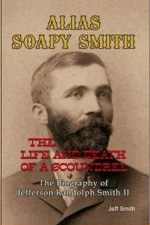
In the early 1880's Sam and Lou teamed up as city marshals in New Mexico.

Sam and Lou Workin' on the Railroad (early 1880s)
It's a bit difficult to imagine Sam & Lou building a railroad, as Lou's obit suggests. Maybe, like Bill Cody, they contracted to grade a stretch of land prior to the railroad gang's arrival, or supplied vital (or not so vital) goods or services. They were true entrenpreneurs, starting and folding businesses like a nut shell man juggling his pea, and might have put their capital towards any of the support services involved in railroading, including mobile saloons, theaters and whorehouses.
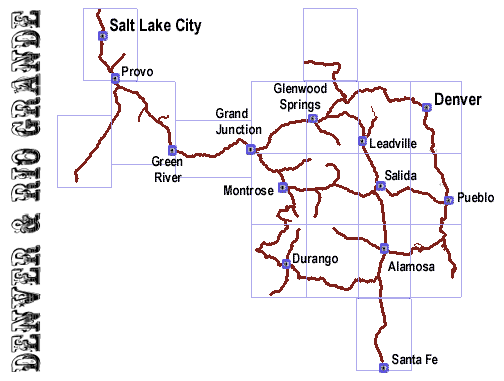
The likeliest timeframe for the boys to be involved with the Denver & Rio Grande Western would be around 1880-82. This was a period of rapid expansion for the D&RG, fueled by fierce competition with the Atchison, Topeka & Santa Fe. It's also the most likely spot in the brother's crowded chronology.
Perhaps, however, they got the wrong railroad. We know the boys were in Albuquerque from '81 to '83, which happens to coincide with a period of rapid expansion for the Atchison, Topeka & Santa Fe, right in the Albuquerque neighborhood. Many private contractors in the area did business organizing work gangs to grade the land before tracks were laid.
Worth noting as well that Silver City, NM, where Lou says he lived in the late 1880s, is on the ATSF line.
| Images, etc.:
|
| Online Resources:
|
Lou as Sheriff of San Angelo, Texas (early 1880s)
Lou Blonger's obituaries indicate that he was elected sheriff of San Angelo (or alternatively, a Texas border town). Lou told the story of Jimmy Smith and Nels Anderson, who shot it out over a San Angelo, Tex., roulette wheel, killing each other simultaneously. Researchers at Angelo State could dig up no evidence of Lou's presence, and no city directory or newspapers exist from this period. The timeline provided by Lou's pension file makes this seem more and more like a tall tale, though the Albuquerque Morning Journal tells us he was visiting from Texas when he first arrived in February of 1882.
Sam, Lou and Joe in New Mexico (1881-88)
Lou's pension file states that the Sam and Lou left Leadville for Albuquerque in 1881 and stayed there until 1883. We now know that Sam Blonger's obituary and the Swinbank account were nearly correct in indicating that he was elected sheriff of Albuquerque. At the behest of local businessmen looking for a little more law and order, Sam was hired by the Bernallilo County sheriff, Perfecto Armijo, in February of 1882, to serve as deputy sheriff. His duties included serving as city marshal of the burgeoning town of New Albuquerque, the hard-scrabble younger cousin of more affluent "Old Town" across the tracks and a mile or so down the road (they dropped the word "New" in July of that year).
The news tells us that Lou arrived in Albuquerque shortly after Sam's hiring, "visiting" from Texas. If he lived in Texas, he made no mention of it in his pension request, though later in life he did claim to have been sheriff in San Angelo, or a West Texas border town (see above). Lou's affadavit jumps from Leadville to Albuquerque in 1881, yet here the newspaper indicates he was new to town in '82.
In no time, the Blonger Brothers were laying down the law, guns blazing. Sam killed no one during his tenure, and I would think that's the mark of a good cop in a rough town. New Albuquerque was known at the time as a rowdy, bawdy place, overrun with horse theives and drunks with guns, "soiled doves," third-rate gamblers called "Kid," "hold-ups" and other stock characters. Putting wagonloads of "vags" on the train, with instructions never to come back, seemed at times to be a daily chore for Marshal Blonger.
In March of '82, a deputy sent to Cerrillos to fetch a prisoner returned instead with one Joe Blonger, whom his brothers had not seen in nine years and had given up for dead. We are told that he had an "adventurous" time in his travels, and that "The three brothers are all of them young, nervy and square western men and it would be a good thing for the town if they were all on the police force." Evidence indicates that Joe had been mining in the Cerrillos Hills since 1879, and that he continued to do so for many years.
In early April, Lou cashed a check for Ben Meyer, who then lost about half of the money in a game of stud-horse poker with somebody else. He then claimed to have been cheated, that Lou had cashed Meyer's check to facilitate his fleecing by the card sharp. So, Ben went to the bank and ordered payment stopped on the check, claiming that it had been stolen. Lou brought suit against Meyer for the amount and was expected to get judgment. This would appear to be the earliest evidence yet of Lou's modus operandi.
In mid-April, Wyatt and Warren Earp, Doc Holliday, Sherman McMasters, James Johnson, John Tipton, and Jack Vermillion left Arizona after taking revenge on the infamous "cow-boys," a cutthroat gang of cattle thieves, for the murder of Wyatt's brother Virgil. Their status as fugitives was in question because of Wyatt's authority as a U. S. Marshal. Once in Albuquerque, Wyatt and his companions wanted to take a breather while things were sorted out between the governments of Arizona and New Mexico. Favors were being called in, and alliances were forming on either side. As revealed in a recently discovered letter attributed to Miguel Otero, later governor of New Mexico Territory, Sheriff Armijo and the Blonger boys were sympathetic, as were many, and the town kept the posse's secret relatively well, until they left for Trinidad, Colorado.
As mentioned elsewhere, we are told that Sam & Lou spent time in Dodge City in 1878. If so, the Blongers, the Earps, and Holliday would have known each other previously. Sam may have even met the Earps in Austin Nevada back in 1864. That would make Sam's Albquerque an inviting hideout.
After a scant five months, Sam's tenure became the subject of controversy, and he was accused in print of "non-performance of duties". He had ardent supporters as well, and even wrote an eloquent rebuttal (though the Evening Review claimed the letter was ghost-written by a Journal employee who was also an ex-Review employee, in addition to being a friend of Sam's), but in early July he was dismissed while out of town.
Upon his return, Sheriff Armijo offered to hire Sam back, but he declined, stating he didn't want the job if the business men (and newspapers) of the town did not fully support him.
Later, a petition was circulated requesting Sam be reinstated, but now the sheriff declined. Lou resigned as deputy.
It is interesting to note that the first marshal of Albuquerque (Sam was fourth, turnover was high), Milt Yarberry, was hanged for murder in 1883. Con Caddigan, elected constable soon after Sam's departure, was no longer welcome after a midwesterner was swindled out of his last $340 and Caddigan appeared to assisting in the con. Yarberry, hanged in 1883, was an early victim of a new-fangled gallows that used a lead weight to jerk the condemned up, rather than letting him drop. "Jerked to Jesus," they said. Caddigan was said to run with a small gang that had worked Deadwood, Denver and Leadville. Among their ranks was Billy Nuttall, showman and former partner in the saloon where Wild Bill met his maker.
In September of 1882, Lou found himself facing assault charges after pistol-whipping a drinking buddy, bartender and aeronaut "Professor" Park Van Tassel, for a vulgar comment made to Lou's girlfriend — who happened to be the madam of the whorehouse they were visiting at the time. Van Tassel was to become a famed balloon exhibitionist, known today as the first man to break the surly bonds in the Territory of New Mexico. This historic flight took place only two months earlier, at Albuquerque's Independence Day celebration. We have yet to discern the outcome of Lou's trial, or the madam's name.
In late 1882, Sam, on a day's notice, ran for town constable as the Republican candidate. Opposing him were Con Caddigan running as a Democrat, and Tony Neis, as an independant, after losing the Republican nomination to Sam. Tony Neis, who had accompanied Bob Olinger while delivering Billy the Kid to trial in La Mesilla, opened the local office of the Rocky Mountain Detective Association, and was a friend of Sam's — and Lou too, who apparently accompanied Neis on at least one manhunt. Sam was soundly defeated; Caddigan took office.
Upon leaving Albuquerque, Sam apparently separated from Lou for the first time since 1866, and joined Simon in the mining camp at Aspen. He was actively engaged in the world of horseracing, and may have continued his career as an officer of the law, or perhaps as a private detective. At some later time Sam would lose an eye during a gunfight, though nothing more is known of this event.
Meanwhile, Lou stated that he spent time with gambler Frank Thurmond and his wife, Carlotta Thompkins, aka Lottie Deno, also a famous sport, in the hills of southwestern New Mexico, Silver City, Deming and Kingston. It was from Kingston that Lou filed for a disability pension on November 7, 1887, and detailed his comings and goings over the past 22 years.
That said, the San Bernardino, California voter rolls tell a slightly different story, with Lou owning a saloon there in 1884. When he came to Arizona for Kitty Blonger's trial in 1888 he stated that he was arriving from San Bernardino.
Likewise, Blonger & Co. are noted as proprietors of Stroud's Theatre in Phoenix in 1883.
Lou returned to Denver by May 3, 1888, when he filed his next pension paper, and never lived outside of Denver again.
Joe worked in the Cerrillos Hills, both as a prospector, and as a miner, and prospected in other parts of New Mexico, in Colorado, Nevada, California, and perhaps Arizona as well. He also served as a guard at Allenville penitentiary, setting of the original version of The Longest Yard.
In 1897, Joe was acquitted of a murder charge after shooting his employer, Alexander Allan. While waiting for materials to continue their work developing the Bottom Dollar mine, Joe and fellow employee Silas Smith informed Allan that they were going in to Santa Fe for a breather. Not wanting to be left alone at the mine, Allan pulled a revolver, threatened the men, then threw down the gun and fought with Smith. In the excitement, Joe retrieved the pistol and shot Allan twice, and he died minutes later.
| Online Clues:
|
| Online Resources:
|
Kitty Blonger (1888)
In 1888, northern Arizona awoke to headlines of "Murder at Peach Springs." A prostitute named Kitty (or Kate) Blonger shot Charles Hill after he tried to enter her room, forcibly, while she and a paramour named Dayton M. "Kid" Fay were in flagrante delicto. In the ensuing trial, Kitty pleaded self-defense, and to the surprise of the reporters of the day, got off scot-free. She was the second woman in Arizona to be tried for murder, and her willfullness and poise in court caused a sensation.
Kitty Blonger's story is another great example of the random bits information one can collect on the Internet. This particular clue came from the Northern Arizona University library Web site, part of a project that covered the years 1887 to 1894. Without the Internet, it's unlikely that we would ever have stumbled across Kitty.
How Kitty Blonger was related to the Blonger brothers was at first undetermined. Marriage records for Lou and Sam were pretty clear at that point. Lou married Emma Loring in 1882, divorced her in 1889, and shortly thereafter married Nola Lyons.
Sam, for his part, married Ella Livingston in 1868, divorced her in 1889, and shortly thereafter married Sadie Wilson. Four years later they were divorced after Sadie charged Sam (for the second time in court) with extreme cruelty. Not long after that, Sam married Virginia Pierrepont.
All things considered, we wondered if Kitty was Joe Belonger's wife or ex-wife.
Then, when we discovered that Lou had come to her aid during the trial in Arizona, we were tempted to identify her as "Blonger's woman," the madam of Lou's whorehouse in Albuquerque. It was not uncommon for prostitutes to take on the surname of their pimp. Further research uncovered yet another Albuquerque prostitute by the name of Mollie Blonger, arrested for maintaining a nuisance just days after Kitty's acquittal.
Then, finally, came an article about two Denver detectives in hot water for allegedly taking a bribe to release a prisoner in their charge. One of the detectives was traveling with a woman -- his landlady -- who went by the name of Kate Blonger, but was also know by the name of her most recent husband, Henry J. Domedion.
Well, that name rang a bell. It was Sadie Wilson who married Domedion after their divorce. Sadie Wilson = Mrs. H.J. Domedion = Sam's second wife Kitty Blonger.
|