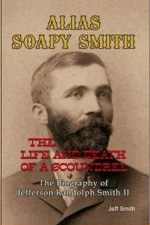
A compilation of newspaper articles from
the Morning Journal and Evening Review,
presented in chronological order.

Albuquerque Daily Journal, November 13, 1881
Confidence Crooks.
The Way They Have Been Gulling the Greenies in Albuquerque.
Some of Their Brilliant Schemes for Swindling Their Victims.
Confidence men can be found in all cities of any size the world over. The sharper ones confine themselves to larger eastern cities and work for big game. Those who are not so well up in their profession take the old worn out games of their brethren in the east and come west to practice them on the unsophisticated. Albuquerque is at present well supplied with this class of swindlers, and it would not be amiss, under the circumstances, to give away some of their schemes. All classes of men fall victims to their wiles. The laborer, the business man and gentlemen engaged in their professions, are equally liable to find themselves minus a few dollars by confiding in some assuming gentleman. Of course a game which would make a laboring man give up his money would not work on a business or professional man, and vice versa. Few of those who get bitten ever say anything about it, but profit by their experience, and take good care not to allow it to occur again.
The laboring classes who have been roped in here, generally had what is called the "mill game" worked on them. Some business like, well dressed man will walk up to his victim and inform him that he owns a mill in the mountains near here, and that he wants to hire some help. He offers big inducements and greenie hires out to him. After he has gained the confidence of the man, his accomplice meets him and presents a bill against the mill. The mill owner finds that he has not quite enough cash in his pocket to settle, and confidently turns to his new employee and requests the loan of five or ten dollars for a short time. If the scheme works he takes the money and shakes the victim to go in search of another.
The "rush game" is practiced on business firms. A couple of sharpers rush into a store, make some trivial purchase and throw out a ten dollar bill in payment. They are in a great hurry and want their change as soon as possible. When the merchant or clerk turns to get the change, the bill is picked up by the sharpers, and relaced in their capacious pockets, and then they take the change as it is counted out to them. The storekeeper asks for the bill and both of the sharpers swear point blank that he has already received it, and as the swindlers have possession of the funds, they have the advantage of the argument and Mr. Merchant gets left.
Probably the thinnest swindle of all, which has been successfully worked in this city, is that known to the "profession" as the "mallet game." A carpenter, or an alleged carpenter, enters a store and leaves some tools for safe keeping until he returns or them. Among these is a mallet. After he is gone one of his partners comes in and slyly changes the mallets. Sharper No. 1, with sharper No. 3, come in soon after to get the tools. A glance at them shows that the mallet is not the one he had deposited. He mentions the fact to the proprietor of the store. A discussion is raised as to the relative value of the tools, which is followed by an offer on the part of sharper No. 3 to bet that the mallet is worth, say ten dollars, or about ten times its actual value. His bet is taken up by the clerk or some bystanders, as it is a sure thing. Mr. Sharper picks up the mallet, takes off the handle, and shows, in a small chamber, a sum of money neatly secreted. Of course the money makes the mallet valuable, and the confidence men win the bet.
These are only a few of the schemes practiced by the confidence men who are in the city. They have every imaginable device for gulling greenies, and there is no telling when you are not betting against a sure thing. The only advice the JOURNAL can give is, don't bet on another man's proposition, even if he will swear that black is white, for you are morally certain to lose.
Albuquerque Daily Journal, December 13, 1881
EGAN'S ETERNITY.
John Egan Comes to Albuquerque to Meet His Death.
The Tragic Ending of a Would-be Bad Man Last Night.
John Eagan boarded the Pacific express at Wallace last night with a ticket for Albuquerque. He was under the influence of liquor, and was continually making gun plays on the train. He picked a quarrel with a gentleman who was on his way to El Paso, and drew his revolver, but was kept from firing by a third person. He also attempted to shoot the brakeman, but without success. He was apparently bent upon shooting some one, and was not very particular about who it was.
When the train reached here he got off the car and started towards town. Suddenly three shots were fired, and then there came another. The platform at the depot was crowded with people, and although the shots were fired right in the crowd nobody knew who did the shooting. Eagan fell with a bullet through his heart, and died without uttering a word.
Who shot him was a mystery to all, and even those who stood right at the side of Egan when he fell could not give any rational account of the tragedy. A dozen stories were circulated as to how it was done. Judge Sullivan took charge of the body, and it was removed to Robbins & Torrey's undertakig shop. It was decided to postpone the inquest until to-day, and the crowd dispersed.
The JOURNAL reporter then commenced to make inquiries with a view to learning who it was that fired the fatal shot. After considerable rustling he discovered that Charles was the man. He made the following statement as to the manner in which it occurred:
"Scott Moore and myself were walking through the train when I remarked to him 'the whole gang is in there.' A man who was sitting near heard the remark and followed me to the door, and said, 'are you one of those fellows looking for the hold-ups?' and I told him I was not, that I was merely talking to my friend in the train. By this time we had reached the platform. He then said, 'you don't want to say anything more on this platform or I'll give it to you,' and then after a moment he continued, 'I'll give it to you any way,' and suiting his action to the word he drew his revolver and fired. I jumped aside and pulled my pistol, and when he fired again I fired. He fell just as he fired the third shot. I never saw the man before and I don't think he ever saw me."
Ronan turned himself over to the officers and is now in their custody. He will have a hearing this morning at 9 o'clock.
The reporter now made it his business to learn something of Eagan. [Start with how how to spell his name.] The only man who knew anything about him suddenly disappeared after the killing, but he was finally found in room thirteen at the Hotel Maden, where he had retired for the night. The newspaper man was admitted to the room and learned that his name was Henry Kehoe, and that he was a chum of John Eagan. He and Eagan are miners, and have recently been employed by Cañon del Agua company at San Pedro. Kehoe knows nothing whatever of the circumstances of the shooting. He said that Eagan was a quiet, inoffensive man when he was sober, but that he had been drinking hard that day and was very drunk when he went on the cars. He did not see any of Eagan's movements on the train, as he was in another coach. Of the history of the dead man comparatively little could be learned. He came west in 1861 and has parents living somewhere in Illinois. He belongs to the order of the Odd Fellows. Kehoe has sixty-four dollars belonging to Eagan, and will see that he has a decent burial.
Charlie has always borne a good character in this community, and there is not the slightest doubt that he was justified in his act.
Albuquerque Daily Journal, December 14, 1881
A VARIETY THEATER.
Con W. Caddigan, the Leadville theatre man, is in the city, and proposes to established here a first-class variety show, providing he is able to secure a building for the purpose. He is the proprietor of the Grand Central in Leadville, and is acknowledged to be a first-class theatre man. He also intends putting in troupes at Silver City and Tombstone.
Albuquerque Daily Journal, December 14, 1881
Charlie had his examination in Judge Sullivan's court yesterday morning, and was discharged, as the evidence showed that he acted in self-defense.
Albuquerque Daily Journal, December 15, 1881
Charlie, who killed John Eagan Monday night, was formerly of Leavenworth, Kansas. He came west to Dodge City seven or eight years ago, and then drifted into New Mexico. He is chiefly noted in New Mexico as a remarkably good billiard player.
The Chinaman who runs the hop joint guards his place every night with a double-barreled shot-gun. It is not safe for anyone to attempt any harm to the establishment, if he does not desire to be perforated with buck shot.
Albuquerque Morning Journal, January 31, 1882
The Earps and a desperado named Doc Holiday are running things with a high hand at Tombstone, Arizona.
Albuquerque Morning Journal, February 2, 1882
Sheriff Armijo, at the request of numerous business men, yesterday appointed Sam Blonger deputy sheriff, with the expectation that he will act as marshal in the new town in the place of J.C. Allen. Mr. Blonger has had considerable experience in official work in the west, and there is no doubt he will make a good and efficient officer. Mr. Allen intends leaving for his former home in Illinois to visit the old folks. He has made a good officer and he has many friends who regret that he has resigned his position.
Albuquerque Morning Journal, February 3, 1882
SWINDLING SCHEMES
A Peddler who Claims to Have a Grievance.
Last evening Tom Henry, a direct descendant of Abraham and a traveling peddler by occupation called at this office with a serious grievance. He had a territorial license giving him the right to travel and sell his commodities all over the land of the Montezumas. Yesterday he was accosted by Sam Blonger, the new city marshal, and told that the license was not good, and he was taken up stairs into one of the offices and told that if he would pay $4.25 he would be let off. He was given the following receipt:
ALBUQUERQUE, N.M., Feb. 2, 1882.
Received from Sam Blonger the sum of $4.25 for fees.
S. H. BLONGER
Going to the old town Mr. Henry called on Major Melchior Werner, and was told that the license was good.
This action of Marshal Blonger has a bad look on its face and he will do well to clear it up. Not for a single moment will the people of this town stand any such crooked action on the part of its officers, as this would indicate.
Albuquerque Morning Journal, February 4, 1882
The Peddler Who Claimed to Have been Swindled by the Marshal Takes the Cake.
The Israelite who kicked up such a row about Marshal Blonger is no doubt a crank, or a regular old-fashioned liar. He told us one thing Thursday night, and yesterday he handed us the following, which tells an entirely different story which we think it but fair to Marshal Blonger to publish:
In examining the article in your paper of yesterday, I find that I perverted the facts. Mr. Blonger, the efficient marshal, never received a cent from me, nor do I hold it receipt from him as stated in your paper, and am very sorry that the whole matter was misunderstood.
Very resp't
WILLIAM HENRI.
The peddler goes by two different names, Henry and Sugar. His license is for Henry, and all goods are shipped to Sugar. Everything looks as if the peddler was an accomplished liar of the first water.
Marshal Blonger received a dispatch from Col. H. L. Taylor of Winslow, ordering him to arrest E. L. Moise. The marshal found his man at the depot about to leave for El Paso and took him in custody. Moise has been employed as clerk in Col. Taylor's store at Winslow, and stole a large amount of goods and brought them to this city. He had shipped them to El Paso by express on last night's train. The goods were ordered sent back to this city by telegram.
Albuquerque Morning Journal, February 8, 1882
[At a meeting of the Board of Trade:]
The question of the marshalship being broached, a petition and subscription to Sheriff Armijo, urging the appointment of Jacob Brenning as marshal in place of Samuel Blonger, now holding the position. On motion, a committee of three was appointed to wait on the sheriff with the petition. Committee — C. R. Williams, J. W. Mass, Mariano Armijo.
This committee was also requested to aid in securing additional subscriptions to the salary of the marshal, and that they see that he gives a good bond.
Albuquerque Morning Journal, February 9, 1882
The marshal question is what seems to be the principal subject of conversation about town. There is a petition in circulation, which asks Sheriff Armijo to appoint Jacob Brennan, as deputy, to act as marshal. Those who have signed this paper are opposed to the present incumbent, S. H. Blonger. It is necessary that two men be on the duty, as the work which the office requires is much more than any one man can attend to, and there is no reason why both of these men cannot work together in harmony. As yet Marshal Blonger has done nothing in his official capacity deserving of censure, and it is but right that he be given a trial. To fill the position creditably a man must have had experience. We understand that Mr. Brennan is a good man; he certainly has excellent backing. It is a hard thing to find a man for the position who will please everybody, and as he must be paid by voluntary subscriptions from the citizens he must be acceptable to a large majority of the business men, if he receives proper remuneration for his services.
The Evening Review will issue its initial number on Monday, the 20th instant. It will be published by W. H. Bailhache & Co, its managing editor will be W. F. Saunders, and its business manager A. L. Bailhache.
Albuquerque Morning Journal, February 10, 1882
In conversation with Sheriff Armijo last night we learned that it was his intention to appoint Celso Gutierres as deputy sheriff to do duty as marshal in New Albuquerque. He will also appoint Jacob Brennan when the petition is presented to him by the board of trade committee. He thinks that the town has grown to such dimensions that it is necessary that at least three men be employed for police duty, and he is perfectly willing to appoint any good man that the citizens recommend. Marshal Blonger is to be retained, contrary to the expectations and wishes of quite a number of citizens. The sheriff takes a practical common sense view of the whole question and will try to satisfy all concerned, and if he can't accomplish this by the appointment of one man he will appoint more. He has everything to say in the matter, and as long as he entertains the views he holds at present the best citizens will endorse anything he may do.
Albuquerque Morning Journal, February 15, 1882
L. H. Blonger, a brother of Marshal Blonger, from Texas, arrived in the city yesterday morning on a visit.
Albuquerque Morning Journal, February 16, 1882
The marshal has declared himself, and the vags must go. The fact of the matter is this town isn't large enough to hold so many of that class of people.
Burns Bounced.
Ed Burns, the notorious hold-up, was escorted to the train last night by Marshal Blonger, and sent on his way south with instructions never to show his theiving mug within the city again. Burns is a dangerous man to any community, but there are others in this town to-day who are equally bad and should be made to travel. Marshal Blonger told a reporter last night that he intended making his rounds to-day to gather the poll tax, and that all men that he could find without any visible means of support, would be compelled to go to work or leave town. We know of a number of individuals who belong to this class, and if the marshal has any trouble in finding just who they are, we will not hesitate to publish their names, as they are known here. The vags, for they are nothing else, must go.
Albuquerque Morning Journal, February 17, 1882
True to his word Marshal Blonger commenced warning the vags out of town, and there are now three less in the city than at this time yesterday.
Albuquerque Morning Journal, February 19, 1882
MAN AND MONEY MISSING.
J. M. Dedrick Absconds with Nine Hundred Dollars
J. M. Dedrick, who has the contract for the mason work on W. B. Childers' brick store, on Gold avenue, is missing. Nine hundred dollars are also missing Friday afternoon. Dedrick called on Whitcom & Medler, the chief contractors on the work, and drew nine hundred dollars, with which to pay for brick and labor. He paid a woman, whom he owed, one hundred dollars, but did not pay either the brick men or the laborers. It is reported that he was seen in the Railroad Palace saloon early yesterday morning, since which time no trace of him can be found.
There are various surmises as to the cause of the man's absence. Some think that he has maliciously and willfully stolen the money entrusted to him, while the fact that he paid off some of his debts places him in a more favorable light. Others think that he has been waylaid and robbed. The truth of the matter, without doubt, is that he started out with the intention of settling honestly, and using the money for the purpose for which it was intended, that he commenced drinking and had soon expended a considerable sum of it before realizing what he had done. Then finding that he had committed himself, he decided to steal the entire amount.
He owned a team of horses, however, etc., for which an attachment was taken out by Whitcomb & Medler, yesterday. While Marshal Blonger was taking charge of the property, J. M. Kinneman put in an appearance and claimed that he had a chattel mortgage on the horses. He threatened to shoot the marshal if he persisted in taking possession of the property. The marshal arrested him and lodged him in the cooler. He was released after giving bail in the sum of fifty dollars, to appear before Judge Sullivan tomorrow.
No one excepting Whitcomb & Medler will lose anything by the absconding of Dedrick. All workmen will be paid in full as soon as they can prove up their claims. Dedrick may show up again, but the chances are slim, and unless he is apprehended by officers of the law, the contractors will be compelled to stand the entire loss. The firm is a sound one, and their loss will not affect their business.
Albuquerque Morning Journal, February 28, 1882
SHOT HIMSELF.
C. C. Davis, a Telegraph Operator, Commits Suicide at Isleta Sunday.
Marshal Blonger received the following letter on his return from Bernallilo, Sunday. It was written Saturday and it was doubtless the expectation of the writer that it would be received on the day it was written. Had it been received at that time it would doubtless have been the means of saving a life:
Marshal Blonger: DEAR SIR—Today's train brings you a man by the name of Davis, an operator, who is slightly off his cabase. He tried to suicide here last night. Davis is a tall, fair complexioned man, about 35, with an unusually long, light mustache. Please look out for him. I think that if he could be taken care of that he would be all O. K. in a few days. Too much whisky is doubtless the cause of his trouble. Very Respectfully,
J. A. EVANS,
Deputy Sheriff of Coolidge.
The man Davis arrived in the city Saturday night and went to the Maden house. He sat down in the office and remained there nearly the entire night, as if in a stupor, saying nothing to anyone. In the morning he took the emigrant train bound south. Arriving at Isleta he was put off, and entering the station, he drew his revolver and shot himself, inflicting a wound which may cause his death. A telegram addressed to W. H. Patton, was received in this city immediately after the suicide announcing the fact, and asking Mr. Patton to inform Davis' brother of the occurrence. As Mr. Patton is not in the city the news did not reach the ears of the brother of the unfortunate man, as no one appeared to know who he was.
The chain gang is being largely reinforced by new town bums, no less than seven of these worthies having been added to the list during the past few days.
A fellow who refused to give his name, was given ten days work on the chain gang by Judge Sullivan yesterday. His love of whisky secured him the position.
Albuquerque Evening Review, March 7, 1882
Two horse thieves who stole two horses from Bernalillo yesterday, loped through town to-day. Marshal Blonger and his brother recognized them at once and gave chase but the thieves were too fast for the law and escaped.
Two roughs last night fired on Marshal Blonger and a party of his brother deputies from an adobe house north of Railroad avenue. They were pursued and escaped. Blonger's party fired eighteen shots at the two miscreants, none of which took effect.
Deputy Marshal J.T. Blonger captured a Colt's 45 early this morning from a man who was making preparations to "run amuck."
Albuquerque Morning Journal, March 8, 1882
SILLY SHOOTERS.
They are Nipped For Once and Will be made to Suffer the Penalty of Their Foolishness.
Monday night J.M. Lewis and C.W. Soper, two mixologists, went out for the purpose of having a little fun. Their idea of fun seemed to be to fill up their skins with bad whisky and fire their revolvers in the air just for the fun of hearing the report. Marshal Blonger heard the reports and deputizing L. H. Blonger and Charlie went in pursuit of the men. They followed them, braving the heavy wind and sand which filled their eyes and faces, to their room, in an adobe building in the northwest suburbs of the city. As soon as the officers came up to the house the two "funny" men commenced firing at them through the window and the officers returned the fire, at the same time getting at a safe distance from the improvised fort. As soon as they retreated the two fellows rushed out, uttering the nearest they could to Apache war whoops, and firing their guns at Marshal Blonger's party, who returned the fire. Soper and Lewis escaped under cover of the storm and darkness, but they were arrested yesterday, and brought before Judge Sullivan who placed them under bonds of one thousand dollars each to appear for examination this morning. This promiscuous shooting and spreeing lawlessness will have to be stopped and these fellows will receive a just punishment.
Marshal Blonger now has rooms above Mrs. Holdaway's grocery.
Marshal Blonger had a chase yesterday after the horse thieves mentioned by our Bernillilo correspondent, but without success.
Albuquerque Evening Review, March 8, 1882
S. M. Lewis and C. W. Soper, the two men who amused themselves Monday night by shooting at Marshal Blonger and his deputies, were to have appeared before judge Sullivan this morning but their trial was postponed until to-morrow.
Marshal Blonger has his office now over the Grocery store of Mrs. M. Holdaway
Santiago Baca received two car loads of Budweiser beer to-day, and has made arrangements to receive a car load every week.
Albuquerque Morning Journal, March 9, 1882
A CUT-THROAT.
An Unknown Man Cuts Andrew Schultz's Throat Yesterday.
Andy Schultz, a blacksmith, who has recently been engaged in thumping music out of a piano in one of the houses of ill-fame on Railroad avenue for the amusement of the guests and inmates of the place, boozed up yesterday. In the afternoon, while in the Ben Ton saloon, a man called him outside, and as soon as he reached the street struck at him with a knife, inflicting a cut in his throat, and ran away. Schultz re-entered the saloon, and with the assistance of one or two men went to Pinger & Co.'s drug store and had his wounds dressed by a physician. On examination, it was found that there was a horrible gash across the throat and several small cuts about the face. He bled profusely, but the cut was not deep enough to be dangerous. Schultz says that he had never before seen the man who attacked him, that he had no quarrel with him and did not know what his motive could be.
Marshal Blonger arrested a man shortly after the occurence on suspicion. He had a razor stained with blood on his person and expressed great fear that he would be lynched. He refused to give his name. He almost admitted that he was the man who did the cutting, but there is no proof against him as Schultz was doubtless too much intoxicated to identify him.
Albuquerque Evening Review, March 10, 1882
Marshal Blonger received a telegram this morning from Marshal Moore, of Lamy, to arrest C. King, of whom a description was given. The offence was not stated. King had left Lamy on the emigrant which reached and passed Albuquerque before the telegram came into Blonger's hands.
Albuquerque Evening Review, March 13, 1882
Two or three days ago Marshal Blonger sent a man down to Cerrillos to take in an individual who was wanted here. The deputy returned without his man but brought to the marshal a far more welcome capture in the form of Joseph Blonger, a brother whom he had not seen for nine years and had long since given up as dead. Joe is the youngest of the three Blonger brothers, all of whom are now in Albuquerque. He left the family circle in Salt Lake City nine years ago and has led an adventurous life since. The three brothers are all of them young, nervy and square western men and it would be a good thing for the town if they were all on the police force.
NOTE: How could Deputy Marshal J. T. be at work before he arrived in town?
One of the fine bay horses Scott Moore drives to his coach, was owned by Billy The Kid, and cost the latter $250
Albuquerque Morning Journal, March 16, 1882
Pleasant Presentation.
Last night a number of the friends of S. H. Blonger assembled at the White House, and, catching that gentleman there between the hours of 9 and 10, conducted him to the restaurant, in the rear of the building. Charlie Montaldo stepped forward, and, in the names of the friends of the marshal presented him with a handsome gold badge. The badge was made by P. E. Curran, of this city, and will be an appropriate ornament to the vest front of our efficient marshal. Mr. Blonger thanked the donors for their handsome present, and expressed himself as greatly pleased to learn that the citizens and business men of Albuquerque were satisfied with the manner in which he had performed his duty as an officer, and said that he would do all in his power in the future to merit a continuance of their approval and support. Several bottles of Mumm's extra dry(®) were then brought in and all united in drinking to the health of the most efficient officer New Albuquerque has ever had.
Albuquerque Evening Review, March 16, 1882
For some time past the friends of Marshal Blonger, who are many and appreciative, have been talking over a little scheme whereby he might be shown that his worth was acknowledged. Their consultation resulted in an invitation being extended to the marshal "to meet a party of his friends in the White House dining room on police business," and nothing suspecting, he walked in last night at the appointed time, finding himself surrounded by friends.
As spokesman for the party, Charley Montaldo then advanced and presented the surprised officer, in the name of his friends there assembled, a beautiful gold badge in the form of a shield, suspended from a scroll, on the latter being engraved the words: "Presented to Sam Blonger," and on the shield, "Marshal New Albuquerque."
The recipient accepted the badge, and in a few feeling words expressed his thanks, after which the party sat down to an appetizing lunch, accompanied by frequent libations of Mumm's Extra Dry, furnished by Charley Montaldo.
The badge is one of the handsomest the reporter has ever seen, and there is probably no one who better deserves such a token of esteem from our citizens than Marshal Sam Blonger, who is one of the most efficient officers in the territory, and certainly the best marshal New Albuquerque ever had.
Dennis McGuire, the brick and stone contractor, one of the many who when they are sober are very good and when they are drunk [a few words apparently not typeset] looked at the bottom of a glass too often last night and tackled Judge Sullivan in the White House with a curse and a blow. He received in return a tap from the baton of Marhsal Blonger over the head that speedily reduced his bump of bellicoseness. He hasn't yet sobered up, however.
Marshal Blonger found out to-day that badge was a birth-day present. He was thirty-five years old yesterday.
NOTE: He was actually 43.
Albuquerque Evening Review, March 22, 1882
Marshal Blonger escorted two holdups to the train last night with instructions to get as far from Albuquerque as possible.
The east end dance hall was closed yesterday by Marshall Blonger the proprietors not being willing to pay the license. One of them, however, lost $21 last night playing pool.
Marshal Blonger's office, in Connors and Wainey's building, was fitted up this morning with a telephone, Price Lane having come back again from Socorro.
Albuquerque Morning Journal, March 23, 1882
Marshal Blonger yesterday continued in the good work he has commenced by requesting five of the hold-ups to take the first train out of town. They went, and those that didn't ride, walked.
Albuquerque Morning Journal, March 28, 1882
The Earps in Albuquerque.
Last night, at a late hour, a JOURNAL reporter learned that the famous Earp boys were headed for Albuquerque, and that they were on the Atlantic express which arrives in this city this morning at 6:18. In the party there are two of the Earps and five of their confederates. These men have made for themselves a name in southern Arizona which has become a terror to the entire country. They are now pursued by the sheriff and a posse, who are desirous of capturing them for the murder of Stilwell, at Tucson, last week. There is a general feud in and about Tombstone between the Earp boys and the cow boys. Virgil Earp was at the time city marshal of Tombstone, and he, with two of his brothers and Doc Holliday, shot and killed the cow boys last October. Since that time there has been a continuous war between the two factions. One of the Earps has since been killed, and Virgil has been wounded and is now at his home in San Bernardino. The rest of the party are outlaws, and fugitives from justice. It is not likely that they will remain in this city, if they stop at all, as they are too shrewd to stay in this locality. Should anyone attempt to arrest them there will be life taken, as they are, without doubt the most desperate men now at large.
Tom Ashton yesterday raised a subscription of $43.50 for "Three Mule Pete," who is now lying in a precarious condition, in old town. It will be remembered that he was kicked in a brutal manner by a third-rate gambler in the White House last week.
A party of roughs rose up on their muscle at the dance hall last night and started up a general row. Marshal Blonger and his assistant, Murphy, entered into the fight and after a short battle placed the men under control and placed them safely in the jail in old town. There were four of them and they were pretty hard citizens. They will receive a trial in Sullivan's court to-day.
The JOURNAL is in receipt of a copy of the life of "Billy, the Kid," written by Pat Garrett. It is neatly printed and graphically written and is deserving of a large sale. It is valuable as a matter of history.
Albuquerque Evening Review, March 30, 1882
Marshal Blonger this morning sent two vags out of the city. They promised to go out on the A. & P. road and there earn an honest living.
Park Van Tassel's balloon is now on the way to this city from California, and will be here by the time the gas works are put in operation.
Albuquerque Morning Journal, April 2, 1882
SHOT GUN POLICY.
A Man Named Jones Attempts to Blow Marshal Blonger's Head Off with a Shot Gun.
This morning about half-past one o'clock a man named Jones, who is in the employ of Wells-Fargo's express company in this city, was in Zeiger's saloon quarrelling and flourishing his revolver about in a dangerous way. The man was drunk, and Marshal Blonger, who came into the saloon about that time, took the revolver away from him. Jones is a man of family and Marshal Blonger therefore took him out of the saloon and started him on his way to his home, which is in the Highland addition. The marshal left him when they got near the railroad track, and just after Jones moved on toward his house he turned toward Blonger and said, "I will have my revenge upon you," or words to that effect. Marshal Blonger paid but little attention to this, considering it only the remark of a drunken man, and returned to Zeiger's. He had been there but a few minutes when he saw Jones come into the room with a shot gun in his hands. The marshal concluded at once that the man was going to shoot him, and so, stooping down, he ran toward him and, catching the gun by the barrel, threw it up out of range of himself. Just as he did this the gun was discharged, and the charge passed over his head and lodged into the wall of the club room, near the upper southwest corner of the saloon. The marshal then arrested Jones and took him to the lockup.
Albuquerque Evening Review, April 3, 1882
BLONGER'S PERIL.
An Attempt at Murder Frustrated by a Nervy Officer.
At about one o'clock Sunday morning, Charley Jones, an employe of the Wells Fargo company, who was in the Metropolitan drinking considerably, became very disorderly and was taken in charge by marshal Blonger, who, knowing his orderly conduct when sober and respectable reputation in general, took the six-shooter from him and started to take him to his home in the Highland addition. At the depot the marshal left him enjoining upon him to go home. Jones, of whom a demon seems to have taken possession, hurled an opprobrious epithet at him, shouting, "I'll be revenged upon you," and then started home. Blonger returned to the Metropolitan, where, a few minutes later, he saw Jones with a double-barrelled shotgun, cocked, approaching him. Watching him closely Blonger waited until he had approached within a few feet when he leaped at him, striking up the weapon. An explosion followed and the whole load of buckshot struck the partition between the saloon and the club room, tearing a hole in it. Blonger secured Jones after a struggle, and he with M. J. Murphy, who had in the meantime become involved in a struggle with Deputy Sheriff Murphy, was lodged in jail for the night. Yesterday they were bailed out, Jones for $500 and Murphy $250. Their trial was to have come off this morning, but a continuance of the case until Wednesday was secured.
Marshal Blonger's conduct Saturday night proved that he is a brave man and no wanton killer. Had he shot Jones, he would have been promptly acquitted.
Blonger is a good one. It takes nerve to jump straight at a cocked shot gun
loaded with buckshot. Dallas Studenmire or Joe Eaton would have shot Jones.
NOTE: Remember what was about to happen to the previous marshal... Two words: Necktie party.
Albuquerque Mourning Journal, April 4, 1882
NEATLY NABBED.
How W. T. Griffin was Placed in the Toils Last Night.
W. T. Griffin has been running a dance hall in Winslow, and, as usual in live frontier towns, much money has been gathered into his coffers. His success was the means of giving him a good credit with business men, and he took advantage of his opportunities by getting as deeply in debt as possible. He closed up his place several days ago and made every preparation to beat his creditors. Giving his mistress all of his ready money and shipping his personal property to El Paso by Wells Fargo express, he started for this city yesterday morning. On the train coming in with him was M. Heise, a Las Vegas liquor dealer, to whom he was indebted $325. On arriving at the Atlantic and Pacific yards, Griffin jumped the train, and it became apparent to Heise that it was not his intention to pay up. Heise, as soon as possible, hunted up the marshal, and told him the circumstances. Time was short, and if anything was done, it must be done at once. Marshal Blonger proceeded to get an attachment issued for the goods Griffin had shipped by express and a garnishee for the express company to deliver them to him. He arrived at the depot just in time to secure the property, and then proceeded to find the man. He was not on the train and the officer very promptly surmised that it was his intention to jump on as soon as it pulled out. When the train started Marshal Blonger, with two or three assistants, was a passenger. When about two miles below the city Griffin had not been found and the search was abandoned. The train was stopped and the officers were about to return without the game when Marshal Blonger surmised that the fugitive might be on the platform of the express car, just behind the tender of the engine. He walked to the front of the train, and there sitting upon a pile of blankets with his revolver in hand was Griffin. He was taken by surprise, and before he had time to say Jack Robinson he was gazing down the muzzle of a forty-five in the hands of Blonger. An order to "throw up your hands" was quickly complied with, and Griffin was taken from the car. He had two more revolvers on his person. He was taken to old town and lodged in jail.
By his prompt and energetic action Marshal Blonger saved two different business men in this city considerable sums of money, and he should be liberally rewarded by them for his work. Griffin's woman will probably return to this city to-day with her rather plethoric wallet, and relieve her liege lord from his difficulty.
Albuquerque Evening Review, April 4, 1882
CAPTURED BY QUICKNESS.
A Fleeing Debtor Finds Three Pistols too Few to Escape Arrest.
Last night, on the arrival of the Atlantic & Pacific train in this city, marshal Blonger was approached by M. Heise, of Las Vegas, who told him that W. T. Griffin, who had been running a dance hall at Winslow, had been on the train and had jumped off at the A. & P. offices. Taking this unusual stopping place into consideration with the fact that Griffin owed several large bills to wholesale liquor firms, among them one of about $300 to the firm of M. Heise and another of over $400 to the firm of Santiago Baca, of this city, that he had closed up his dance hall and shipped his goods by the same train to Colorado, Texas, and that his wife was on board the train bound for the south, the creditor presumed that the quondam saloon man's intention was to defraud him and others who had confided in his honesty, and accordingly called upon Blonger to stop the fugitive and his goods. Only a few minutes was there to work in, and Blonger made the best use of the time. Procuring a garnishee upon the Wells Fargo company, the goods belonging to Griffin were secured, and the next step was to catch their owner.
Ernest Myers, of Santiago Baca's, Lou Blonger, Dan Sullivan and Charley Ronan were pressed into service as a posse and the five jumped on the outgoing Santa Fe train, arranging with the conductor to stop at the A. & P. offices, while a sharp look out was kept for Griffin, who was expected to make an attempt to board the train there. Griffin fell into the trap and as the cars passed the coal chutes at the A. & P. yards, he ran out from his concealment and leaped on the platform between the express and baggage cars. He was seen by the posse, and the train was immediately stopped, the posse running up on Griffin from both sides of the car. It appears that he had anticipated pursuit, for he sat on the platform prepared to stand off twenty men, as he thought, two six-shooters resting on his lap, another is his hand, none of which he had a change to use. As soon as Blonger saw him he was covered with the marshal's six-shooter while the rest of the posse secured and disarmed him.
Griffin was then taken to the east end jail and afterwards removed to the west end pen where he remained all night.
Albuquerque Evening Review, April 5, 1882
W. T. Griffin, the well-heeled man, has settled up with his creditors, Santiago Baca and M. Heise, and has been released from custody. As was expected, his spouse returned yesterday with the funds of the concern.
Albuquerque Morning Journal, April 6, 1882
Murphy and Jones, who were arrested for the attempt to shoot
Marshal Blonger, were each fined $50, which they have paid.
Albuquerque Evening Review, April 6, 1882
The Journal makes a mistake in this morning's account of the
release of Jones and Murphy from their bonds. Jones was fined $50 for the
offence with which he was charged, but Murphy was released without fine. The
latter makes a damaging statement concerning the officers by whom he was
arrested, to the effect that while he was in their custody he was relieved of
nearly $20, by whom he does not know.
Albuquerque Morning Journal, April 8, 1882
Cashing Checks.
A man named Ben Meyer, a country merchant doing business in one of the neighboring camps, has been in the city for several days seeing the sights. A couple of nights ago he received the cash for a check from Lou Blonger and then lost about half of the money in a game of stud-horse poker with somebody else. He claimed that he had been swindled out of his money and perhaps he was, and for this reason he went to the bank and ordered payment stopped on the check, claiming that it had been stolen. Blonger now brings suit against Meyer for the amount and will certainly get judgment.
NOTE: This may be the earliest glimpse of Lou the Swindler.
NOTE: On or about April 15, 1882, Wyatt Earp and his posse, including Doc Holliday and Wyatt's younger brother Warren, arrive in Albuquerque by train.
Albuquerque Evening Review, April 18, 1882
Marshal Sam Blonger goes to Denver to-morrow with samples of ore and maps of the Star mine in Hell canon. The Star now shows an eighteen foot vein of pay ore between walls, and the samples from it which Blonger will carry with him doubtless attract great attention in Denver.
Albuquerque Morning Journal, April 19, 1882
Marshal Blonger left this morning for a business trip to Denver.
The editor of this paper leaves this morning for an extended trip in northern Arizona, and will be away several days. It is his determination to place the JOURNAL in the hands of all the business men of that vast region.
Albuquerque Evening Review, April 19, 1882
In the absence of Marshall Sam Blonger, his brother, Lou Blonger, holds the peace and quiet of the town in the hollow of his hand.
Albuquerque Evening Review, April 20, 1882
Leonie Winter is one of the ladies who, from the nature of their business, have to do a good deal of confiding, but her trust was rudely betrayed yesterday. Desiring a cook and an assistant she hired two young rats around town to occupy the positions, and placed them in charge of the house while she went out for a while. When she returned the two young scamps had vanished, as well as a lot of silver plate, and various little articles easy to carry away. Lou Blonger was notified, and a hunt began for the two young thieves, which terminated in their arrest at eleven o'clock last night, by Tommy Lynch, and their incarceration in the city bastile for the night. The stolen property, however, was not found, and as it was thought the boys had been used as cat's paws for some one else, they were this morning released on condition that they should pursue their way toward the setting sun.
Of the three columns of so-called "local" matter in the Journal this morning, one column and a half is copied from other papers, another column is made up of items re-written from yesterday's REVIEW, half of which, at least, might have been published in Wednesday's Journal; one of the remaining six items was published a week ago by this paper; two more are mere office pick-ups of the reporter; another two, incorrect; and the last - the only one of genuine merit in the paper - is "The building boom on Gold avenue gives that street a lively appearance." This is a dissection of the Journal's columns that could be made every day. For news THE REVIEW is the paper.
Albuquerque Morning Journal, April 21, 1882
The local [editor] on the Review, thinking that he would get up a sensation, announced in Wednesday's paper that thirty-five soiled doves from St. Louis would arrive last night and pitch their tent on Railroad avenue. He must have been short of items.
The local editor of the Review lays the flattering function to his soul (we presume he has one) that the JOURNAL copies from his sheet. Whenever the JOURNAL can not furnish reading matter enough without copying from that paper, we will close shop and go west.
Albuquerque Evening Review, April 21, 1882
Leonie is in distress again, which is this time shared by the inmates of "555." This morning, at about four o'clock, some drunken men out on a senseless lark amused themselves by breaking, with stones, the windows of the two houses spoken of, three being broken in "555," and one in Leonie's. Lou Blonger says he knows the authors of the mischief, and if they want to avoid trouble they had better "walk up to the cap'n's office and settle" to-day.
Albuquerque Morning Journal, April 22, 1882
Our evening contemporary fills its columns with slurs at the JOURNAL - a pretty good scheme to get his sheet advertised in the leading daily of New Mexico. The free notices we gave him yesterday were bestowed through a charitable spirit, but hereafter we must have fifty vents per line for complimentaries or they don't go.
In obedience to a telegram from Las Vegas [N.M.], Mr. Lou Blonger, acting city marshal, met the south-bound train Thursday night to arrest a man known as "Gambler Jim." Jim is wanted in Las Vegas to answer to a charge of robbery. He is described as being about five feet eight or nine inches in height, dark complexioned and wearing a black suit of clothes. Mr. Blonger arrested a man answering the above description, excepting his coat was of light color. He searched him, but could find nothing identifying him as being the party wanted, and he was told to skip and he
skooped.
Marshall [Lou] Blonger informs us that while making his rounds yesterday evening, he discovered that several of the windows in one of the gilded cottages had been demolished, and upon inquiry learned that some roughs had done the work about 4 o'clock yesterday morning.
Albuquerque Morning Journal, April 23, 1882
Marshall [Lou] Blonger arrested to men yesterday for stealing a lot of hides from Oberne, Hosick & Co.'s warehouse. They offered them for sale to Mr. Thomas F. Keller, but that gentleman recognized the hides as belonging to the above named firm, and told the men that he would take them but they must wait till the bank opened to get their money. When they returned for the pay, officer Blonger scooped them in and they are now languishing in the lockup. They will have a hearing before Judge Sullivan to-morrow.
Albuquerque Evening Review, April 24, 1882
Lou Blonger jailed a drunk Saturday night, and discovered Sunday morning when he went there, that the fellow had just recovered from the small-pox, the disgusting scabs being still fresh. Blonger turned him out with great alacrity, and told him that if he would leave town he should not be tried. The proposition was accepted and the man trudged west.
James Downing, the El Rito quarryman, was run in early Sunday by officer Blonger on a charge of "drunk and disorderly." Downing was visiting some of the pleasure resorts on Fourth street and happened in "77" where he ordered beer and paid for it; after which he started to enjoy himself by presenting a six shooter at the head of the girls. One of them ran out and informed Blonger, who, after a little search, struck his man making another pistol play on the street and placed him where his antics would do the least harm. Yesterday morning the matter was arranged by his friends and he managed to pull himself together and get out of town to-day.
Marshal Sam Blonger telegraphs from Denver that he will be here next Thursday.
Albuquerque Evening Review, April 25, 1882
Charles Wallace was arrested last night by Lou Blonger for passing a forged check for $15 on the Central bank to J. M. Moore. Wallace presented the check, which was signed by W. T. King, to Moore and endorsed it with the same name, receiving $10 on its account. The bank pronounced it a forgery and Blonger was informed of the matter. Wallace was found in a gambling room, where he had just blown in the money he had obtained by the forgery, and was jailed.
Albuquerque Evening Review, April 26, 1882
E. M. Bernard is no longer connected with THE REVIEW as carrier, A. L. Bailhache having sole charge of the circulation now.
Albuquerque Evening Review, April 27, 1882
Them Awful Hold-Ups.
The hold up affair of Carpenter's results in a good joke on Lou Blonger, Nute Hinch and Billy Anderson. It appears that on the night in question a drunken fellow came around to the room where Nute and Billy were and made himself decidedly too noisy to be tolerated. Hinch got up and went to the door with a beer bottle in his hand, which the tough mistook for a gun and incontinently fled. He returned in a few minutes and posting himself out-side of the house, hurled a bottle through the window of the room, breaking the lamp and the wash-bowl inside. He then took to his heels again. Anderson and Hinch got up and dressed themselves, and started out in pursuit, striking Carpenter on the way who was meditatively making his way home. The amateur detectives thought he looked something like the man of whom they were in quest and told him to stop. Carpenter obeyed, at the same time bringing a revolver in his pocket to a "ready." He didn't know Anderson or Hinch and they didn't know him, so they carefully inspected his face and figure and finally decided he wasn't the right man. Carpenter pursued his way with the proud feeling that he had bluffed two dangerous thugs and Billy and Nute went on. They found their man later who fixed the thing all right by apologizing and settling the damages.
Yesterday Lou Blonger got wind of the affair and thought he had found a pretty good clue to work on for the sinching [sic] of some hard characters in town. He was confident that he knew the hold ups whom he described as being pretty desperate characters, and he laid a fine trap yesterday to take them in, expecting to find them in the dance hall. Hinch was sick last night and Anderson was studying up a new summer drink, so Blonger did not catch on to his perfect satisfaction and he probably will not know until this catches his eye the reason for his disappointment. He and Carpenter will have to call around at the Maden House or the Board of Trade and take a drink on these terrible hold-ups to get even.
Albuquerque Morning Journal, April 28, 1882
HORRIBLE HUMANITY.
Many of our readers have no doubt read Victor Hugo's "Les Miserables," wherein the sad history of a galley slave is dedicated. The tender-hearted have wept over the woes of the fugitive, and the philosophic have wondered if such misfortunes could exist in civilized communities. Until yesterday we thought Hugo's story the romance of a vivid imagination, that such suffering would not be allowed where God was recognized, and the story of Jesus had been told. Yesterday unfolded a different story and proved that the boasted humanity of the Rocky mountain region was a lie, and that the people of a city of several thousand professedly civilized people were meaner than the heathen of the Pacific islands, and that Hugo's galley slave was fortunate in falling into the hands of the French people of the past century. The circumstances are these: A workman on the Atlantic and Pacific railroad was stricken down with small-pox. He was slumped into a box car and brought to this city night before last. The rumor went round that a small-pox subject needed attention, and Judge Dan Sullivan, Mr. Elwood Maden and a few others raised a fund to provide for his care and treatment. No room could be procured. All day yesterday the poor wretch lay near the depot without care or attention. No doubt to that poor soul the [...]ities and misery experienced by Coleridge's Ancient Mariner is a vivid reality. There he lay shunned and neglected by his fellow men, with a burning sun beating upon his diseased and tortured body. Fellow citizens, let us not be heathen. Let us not imagine that the accumulation of wealth is all and everything in this life. Let us go to work and provide a home for the sick and distressed among us. In a region much like this, Jesus of Nazareth won the reputation of being of divine origin by kind acts to the poor and suffering. Here we have a flourishing, rich city; two powerful railroad corporations; [?] several benevolent institutions and yet a fellow being is left to die and rot on a public street, without care or attention. It is barbaric. It is an outrage on civilization.
It is said that coporations have no souls; but the Atlantic and Pacific Railroad company os a happy exemption to the truism. Late yesterday afternoon [?] of this incorporaton heard of the unfortunate small-pox patient, who sufferings [...]ed forgotten by his fellow-men, they took charge of him, and moved him to a place where he could be taken care of and where he would not breed pestilence in the community. This action reflects credit on the Atlantic and Pacific management, and proves that that company wish to do the right thing with its employes.
Albuquerque Evening Review, April 28, 1882
The Journal slops over this morning in a column of sentimental gush concerning that small-pox patient, which is as undeserved an insult to the people who support the paper as it is untruthful. The man was brought into Albuquerque by a friend of his, who, with others, has been constantly with him since his arrival; his wants have been carefully attended to, and he has been under shelter since he came. The object of the Journal in printing such a mass of abusive lies reflecting upon the people of Albuquerque, is hard to understand. THE REVIEW is willing to grant commendation to the officers of the Atlantic & Pacific road, who have secured a tent and medical assistance for the patient, but it fails to see that the corporation has done in this any more than its duty. The sick man was an employe of the company, and his first claim was upon it. The Journal would please its subscribers better if it employed writers who can do their work without the aid of a distorted imagination.
Lou Blonger took two vagrants to the depot yesterday, and set their faces toward the setting sun. They form the van-guard of the Journal's squad of Navajo-fighting young men.
NOTE: On or about April 29, 1882, the Earp posse departs for Trinidad, Colorado. Holliday left earlier after an argument with Wyatt.
The Earp posse's stay in Albuquerque is described briefly in a letter written in 1940 by Miguel A. Otero, who served as territorial governor from 1897 to 1906. The letter was found by Chuck Hornung, an Earp researcher, in 2001, and among other things states that while in Albuquerque, "Blonger and Armijo watched over the boys."
We will be posting the complete text of the letter here soon. In the meantime, you can find the text, and a lengthy discussion of the letter, in True West magazine, December, 2001.
Albuquerque Morning Journal, April 29, 1882
Acting Marshall Blonger is in receipt of a letter from Mrs. Annie Moore, dated San Francisco, Calif. April 23. She writes that her husband, John Moore, left her in company with a woman of questionable character and was last heard of at Socorro. We [...] that the man wanted is in custody.
Lou Blonger has returned all the money raised by subscription for the man was sick with varioloid at [...] the other day. The Atlantic & P. road took charge of the p[...] and [...]ove him out of town.
Albuquerque Evening Review, April 29, 1882
Lou Blonger garnisheed Johnny Campbell this morning in the case of James Basye vs. Thomas Parker for money due the plaintiff.
The Journal is hardly so humorless to-day as it was yesterday. Even great wits grow dulled sometimes. Seriously, the Journal would do much better if it would condescend to give its subscribers news instead of giving up its local columns to an amateur Artemus Ward, who doesn't know a good joke from a chapter of the New Testament.
Albuquerque Morning Journal, April 30, 1882
Lou Blonger jugged two Mexicans last night who were displaying their six-shooters in the dance hall.
Albuquerque Evening Review, May 1, 1882
The Santa Fe New Mexican copies the libelous and lying statement of the Journal about the man who was brought in here the other day ill of the small pox, and taking its cue from the utterly senseless and insulting condemnation of the people of Albuquerque by the Journal, says some very severe things about this city and its citizens. The falsehood of the Journal will travel faster than THE REVIEW's truth in this case, and correction of the lie will in but few cases be obtained, where it has once been published. It would seem from the Journal's abuse of this town and its people that it is preparing to move to Las Vegas, and is trying to make itself solid with its future patrons. It would do a graceful thing now by asking pardon for the outrage it has committed upon the town by which it is supported.
The Arizona papers do not like THE REVIEW's comparison between Governor Sheldon and Tritle, as inferentially, it was rather unfavorable to the governor of that cow-boy ruled territory. Words cannot express the regret felt by this paper, from the editor-in-chief to the office boys, for this unhappy result of a four line paragraph. We would like to apologize to the actual governor of Arizona, but as at present it is somewhat uncertain whether the Stillwells, Tritle or the Earp boys really run the territory, the intended reparation will have to be deferred.
Albuquerque Morning Journal, May 3, 1882
The following parties arrived at the Hotel Maden yesterday:
Louis Blonger, Las Vegas
Albuquerque Morning Journal, May 4, 1882
Marshal Sam Blonger, during his recent trip to Denver, negotiated the sale of the Star mines for $120,000. The purchasers are expected to arrive Saturday next.
Deputy United States Marshal Tony Neis, of Santa Fe is in the city on matters of business. "No news of importance at Santa Fe," was his answer to the inquiry of a reporter.
Albuquerque Morning Journal, May 6, 1882
The goggle-eyed slanderer of an evening contemporary was beautifully brought to time in front of Armijo house yesterday by a gentleman who would not brook the insults of his pusillanimous sheet. He took it like a culprit who deserves his punishment.
Albuquerque Evening Review, May 8, 1882
Deputy Sheriff Sam Blonger announces to the reports of THE REVIEW that they need expect no more news from him and that his efforts hereafter will be directed to keeping such information as he may command from this paper. This is gratifying. Hereafter, criminal news published by THE REVIEW will be more reliable. It may be interesting for some to know that Mr. Blonger's dislike of this paper dates from the discharge of a reporter who was formerly weak enough and fond enough of liquid and nicotan [sic] stimulants to espouse the cause of the officer whenever a dark-looking case came before the public, and the fact is probably of the same degree of interest that this reporter is now employed at the Journal. THE REVIEW is published as a newspaper, and any of its reporters who suppress the news will be promptly scut over to the Journal office with a letter of recommendation.
Albuquerque Morning Journal, May 9, 1882
Thos. Hughes, live editor of the Albuquerque JOURNAL, is in the city, greeting numerous friends. Mr. Hughes, who is a former Kansan, is achieving quite a success in New Mexico journalism, and is well pleased with his surroundings. -
Topeka Capital
Albuquerque Morning Journal, May 10, 1882
Wantoness.
The exhibition of wantoness displayed on one of the public streets yesterday, was revolting in the extreme, and a due consideration of the subject shows that something must be done to enforce common decency in our city, to protect ladies from insult and oust that class of people who are of no use whatever but a nuisance to society. When we reflect that this turbulent element is expected to be kept in subjection by one officer, the city marshal, for there is no other one on duty in the east end, it can readily be seen that such a thing is beyond the power of one man. He must have rest, and while he is off duty the rabble may ply their nefarious games with impunity. Now the question arises what is to be done to remedy this unsatisfactory state of affairs. The only solution of the problem that presents itself calls for immediate action on the part of our citizens to raise funds and employ additional police force.
There is an element in this city which, if given an inch, would ride over all rules of decency and law. They must be made to feel that the law has a powerful hole [sic] upon them or they will take it upon themselves to trample upon the right of respectable people. The present city marshal is deserving of praise for his efforts to preserve order in the city and enforce the law, but as we before remarked, it is requiring too much of one man.
Albuquerque Morning Journal, May 11, 1882
The United States marshal for New Mexico will soon open a branch office in this city, with Sam Blonger as agent. He could not make a better selection for an officer.
Albuquerque Evening Review, May 11, 1882
The statement which appeared in this morning's Journal that Marshal Morrison had appointed Sam Blonger deputy marshal for New Albuquerque, is denied by Mr. Morrison, who states that he has not given the subject a moment's thought and that he is not even acquainted with Mr. Blonger. Major Werner is the only deputy appointed by Mr. Morrison, and the only one likely to be for some time. Evidently there is a falsehood somewhere, and it isn't with Marshal Morisson either.
Deputy Sheriff Blonger's employes, who are temporarily employed by the Journal to decrease its circulation among respectable people, had a word to say yesterday to the effect that the officer was greatly overworked and needed assistance in the performances of his arduous duties. This is a very neat bit of sarcasm, coming from the Journal, although the point made was evidently entirely unintentional. What is Mr. Blonger's arduous duty and how is it performed? Everybody knows that it is not hunting for dangerous characters or criminals. The Journal states that the people of Albuquerque appreciates this deputy sheriff's services. So they do, but they do not appreciate them as the Journal does. There is a wide difference between what the Journal says and what the people think.
Albuquerque Morning Journal, May 12, 1882
Elsewhere in this issue will be seen the card of Marshal Blonger. When we consider the source of the charges preferred against him we are surprised that he should take any notice of it. As far as the reporter knows Marshal Blonger has given entire satisfaction as marshal of the town and we have never heard of an instance where he has failed to uphold the law and discharge his duty as an officer, except in the one he alludes to in his card.
A Card.
Inasmuch as the dirty quill driver on the twilight sees fit to attack me in my official character, I take this occasion to make a statement. I know that a refutation of any charge which may emanate from that source would not be accredited by the old residents of this city, who are familiar with the reputation of the writer, but there are others, not acquainted with him, who might be induced to believe what he says, and for that reason only I appear in this card. He charges me with non-performance of duty as marshal of this city. If there is one respectable man out of a hundred in Albuquerque who says that I have neglected my duty, then let him come forward and I will resign the office. In my recollection there is only one instance where I have omitted to carry out the requirements of my position, and that was when I failed to arrest Saunders, local of the evening sheet, on one of his drunken sprees, when he drew his pistol, indulged in indecent language and otherwise made himself obnoxious to the community. During that same spree he visited one of the houses of ill fame in this city and conducted himself in such a way that the proprietress of the place had him put out of the door.
A short time ago an item appeared in the JOURNAL stating that I had, in performance of my official duty, closed up the "Gem," a notorious house of ill fame. On the face of this the sundown sheet attacks me, and has kept it up ever since. But, anterior to this, on March 16, on mentioning the presentation of a badge to me, by the citizens of Albuquerque, he said:
"The badge is one of the handsomest the reporter has ever seen, and there is probably no one who better deserves such a token of esteem from our citizens than Marshal Sam Blonger, who is one of the most efficient officers in the territory, and certainly the best marshal New Albuquerque ever had."
This is the last time I shall take notice of anything that may appear in that obscure sheet, and if any man
of standing will prefer and substantiate the charge of non performance of duty
as a city official, then I will step down and out. Respectfully,
SAM BLONGER
City Marshal
Dr. Easterday yesterday reported a case of small pox in a box car below the depot. The patient is a boy recently arrived from Tombstone,
A.T. [Arizona Territory] Marshal Blonger started around with subscription to raise funds for medical attendance, etc. It is hoped that our citizens will respond liberally to this charitable call, for should the case be left where it is a terrible epidemic might grow out of it. It is to be regretted that there has been no provision made for treatment of small pox cases, but it is not too late yet to take steps in this matter.
Albuquerque Evening Review, May 12, 1882
A card written by E. M. Bernard and signed by Marshal Sam Blonger appeared in this morning's Journal. Mr. Bernard is the gentleman who was referred to by THE REVIEW a few days since as having been discharged from this paper.
When Deputy Sheriff Blonger takes snuff now, the Journal sneezes. This, for a paper which a month ago had an opinion on the Chinese question, is something of a fall.
Albuquerque Morning Journal, May 13, 1882
Mr. Tony Neis desires as to make a correction in regard to the appointment of his deputy at this place. We erroneously stated that Mr. Sam Blonger had received the appointment of deputy United States Marshal when it should have been agent of the detective force for this precinct.
The following articles appeared after the Earp posse left town. Wyatt apparently visited the Review offices, but requested that any mention of his presence be withheld until after his group's departure.
A short excerpt from the longer article is noted in Wyatt Earp: The Life Behind the Legend, by Casey Tefertiller (John Wiley & Sons, Inc., 1997, p. 255), but unaccountably the text does not match that shown in the image below.
Mark Dworkin covered the incident in more detail in "Henry Jaffa and Wyatt Earp: Wyatt Earp's Jewish Connection," an article he wrote for the Western Outlaw-Lawman History Association Journal, Vol. XIII, No. 3 (Fall 2004).
Albuquerque Evening Review, May 13, 1882, pg. 2
The Earp boys, two of whom it is thought have exchanged the compliments of the season with Frank Stillwell, were singular types of desperadoes, if they were desperadoes. Removed from the scene of their conflicts with enemies, they became no more rioters than the frontiersman in general, and from their deportment those unacquainted with them would have taken them quicker for hard-working miners than for the men the result of whose work called out a proclamation from the president. Your true fighting man talks very little of his exploits.
Albuquerque Evening Review, May 13, 1882, pg. 3

DOWNED AT LAST
Wyatt Earp Killed Near Hooker's, Arizona
On the fifteenth of last month a party arrived in Albuquerque on the Atlantic & Pacific whose appearance in the city speedily became known among the rounders and talked about. They were men of whose deeds the whole of Arizona was ringing, the Earp boys, as they were all together spoken of. During the month before they had been hardly a day during which a cocked revolver had not been leveled at some one, seven dead cow-boys bearing witness to the accuracy of their aim. The whole story of the fights between them and their enemies is too well-known to require a repetition here. They had fought well and bitterly, taking two lives for each one they lost, until the law grasped them and indictment after indictment began to be found against them. Then they left Arizona and came to Albuquerque. The party as they came here was composed of Wyatt Earp, Warren Earp, "Doc" or John Holliday, Sherman McMaster's, James Johnson, John Tipton, and Jack Vermillion seven, in all.
On the morning after their arrival, and before more than one or two knew of their presence, Wyatt Earp called at the REVIEW and Journal offices, and had an interview with the reporters of both papers. He stated that they had come to Albuquerque to escape persecution while awaiting the result of an effort being made by Governor Tritle to secure their pardon from the president; that they were then being sought for by their foes, and that they would not give themselves up to the Arizona officers without resistance. In view of these facts, Earp requested of both papers that their temporary sojourn in Albuquerque should remain unnoticed until they could be assured that the knowledge of their whereabouts would not bring a party of cow-boy avengers down upon them. To back his assertions regarding Governor Tritle's feeling toward them, Earp presented THE REVIEW several convincing documents, and his request was accordingly granted by this paper, as it was by the Journal.
The party remained in Albuquerque for a week or more, their identity being well known to fifty people or more, leaving the city nearly two weeks ago. During their stay here "Doc" Holliday and Wyatt Earp quarreled, and when Albuquerque was left the party disbanded, Holliday going with Tipton.
Notwithstanding the fact that the newspapers did not speak of their arrival here, it became known in Arizona, and Tombstone supplied a party of man-hunters, who, it appears from Arizona papers received this morning at last found their prey. The Epitaph gives an account of the killing of Wyatt Earp near Hooker's, Arizona, last Monday, by a party which ambushed and attacked him while the Citizen indorses the news, adding the statement that Tipton was killed last week while with Doc Holliday. No particulars are published of the killing as both papers received their information through private sources. Wyatt met his death while returning from a visit to his wounded brother, at Colton, California, who had but the week before assured a citizen of Tombstone that all of them would, as soon as he was well, return to Arizona and stand trial on the charges preferred against them.
The party, while in Albuquerque, deported themselves very sensibly, performing no acts of rowdyism, and this way gained not a few friends for their side of the fight. It appears that in Tombstone a general feeling of regret that instead of these last two murders the party were not tried fairly in open court prevails.
NOTE: Wyatt, of course, was still very much alive. The quarrel referred to would be the same one mentioned in the Miguel Otero letter.
Albuquerque Morning Journal, May 14, 1882
At no time in their lives did the Earp desperadoes call at the JOURNAL office. They seem to have consorted with the sandy sorehead of the sundown sheet while they remained in hiding in this city.
Yesterday afternoon Marshal Sam Blonger arrested two men on suspicion that they are the parties who broke into Blain Brothers store last Thursday. They are confined in jail and will be tried on Monday.
Albuquerque Morning Journal, May 18, 1882
FRANK JAMES IN ALBUQUERQUE.
How the Renowned Desperado was Gobbled by the Marshal Yesterday.
About noon yesterday a report came to our ever-alert city marshal, S. H. Blonger, that the redoubtable Frank James, elder brother of Jesse, the late lamented, had made a raid upon the house of Madame Volante, and with a forty-five caliber pistol of latest improved pattern, actually forced the well known proprietress to give up her jewels - all this in broad day light. The daring Frank fled after accomplishing his object, and was seen to enter the Armijo House. Upon telephone information the marshal followed the desperado hot on the trail. The description was accurate enough for all necessary purposes. A man was found quietly seated on the pedestal erected to the uses of the gentleman who gives polish to the pedal adornments of the guests of the famous hostelry.
Our marshal said, "Have you a gun." "Yes, in my valise up stairs." Here a star of the first magnitude was displayed and a search being instituted, a lead pencil, a poker "chip" and a medal bearing the legend, "Good for one drink - Reese and Loebner." Various friends, including Tom Park, Charley Armijo, Colonel Hawley and Governor Sheldon came to rescue of Mr. James and with the circumlocution of a habeas corpus established conclusively the fact that the supposed Mr. James was no other than Al Hood of Las Vegas, of the San Miguel national bank and of the telephone company of New Mexico. The marshal promptly sat up the drinks, and Al leaves to-day for Chihuahua.
The actual culprit (maybe Frank James) was subsequently found trying to swim the Rio Grande two miles west of town.
Las Vegas Optic, May 19, 1882
HOOD "HELD UP."
He is Mistaken for Frank James in Albuquerque.
Our town man, A. G. Hood, of the San Miguel national bank, had an experience in Albuquerque the other day that he will not soon forget. Several days ago he packed his grip and boarded the south-bound train for the purpose of establishing a telephone exchange in Chihuahua, Mexico. Meeting a number of old acquaintances in Albuquerque, Al. concluded to spend a day in renewing former friendships, but hardly had he deposited his baggage at the Armijo before rumor began to float around that the notorious Frank James, brother of Jesse James, was in town. Crowds collected in the saloons and on the street corners to discuss the matter and devise some means of capturing the famous outlaw without unnecessary loss of life, for all were familiar with the desperate character of the meek-looking stranger. The report spread, as only such rumors can, and in an inconceivable space of time the sheriff of the county with his deputies, and the city marshal with about fifty solid citizens, all armed with Winchesters and shot guns, surrounded the Armijo house where the supposed bandit was stopping and demanded his surrender. Scott Moore by this time appeared on the scene, and, being told by the sheriff that he was entertaining the most bloodthirsty of living outlaws, fled to the old town and has not been seen since. After consuming almost an hour in demanding that Fran come out and give himself up, without avail, the marshal, backed by twelve picked men, boldly entered the hotel office with level guns.
The clerk stood behind the counter, shivering and speechless, but the hunted fugitive was not to be seen. Cautiously advancing, a break for the saloon was made, and there, all unconscious of the excitement he had created, stood Al. alias Frank leaning upon the bar quietly sipping lemon and sugar. "Throw up your hands!" thundered the marshal, and instantly twenty cocked guns were pointed at his head. The command was obeyed and as strong hands seized him Hood thought his time had come. A thorough search into his pockets, boots and hat brought forth only a jack-knife and a cork screw and then it dawned upon the victorious marshal that possibly he was mistaken. Hood protested against such treatment, asking what he had done and when told that he had been arrested for Frank James, it is said that he swooned and fell into Johnny Campbell's arms. Explanations followed, Hood's identity was established, the marshal and the posse looked disappointed and chagrined, and Scott Moore's bar had the biggest day of the season.
Albuquerque Evening Review, May 20, 1882
Yesterday afternoon, W. F. Saunders, of THE REVIEW, swore out a warrant before Justice Martin, of precinct 13, for the arrest of Justice Sullivan, of precinct 12, claiming that he was in fear of bodily harm ensuing to him from the acts of said Sullivan. The case was tried at the office of Justice Martin, in Rancho Seco, at six o'clock yesterday afternoon. Mr. Saunders testified that that morning he was called out of the office of THE REVIEW by Justice Sullivan, who stated in a threatening manner that he wished an unqualified retraction of every thing that appeared in the paper before relating to him, and if this was not made in THE REVIEW of that afternoon, he would and means to compel it to be done. Justice Sullivan claimed that he was excited at the time, and had no intention of inflicting personal violence upon Mr. Saunders. Justice Martin, after hearing the case, dismissed it, imposing the costs on the plaintiff.
Albuquerque Morning Journal, May 21, 1882
CHRISTMAN CAUGHT.
The Burglar Who Entered and Robbed the Robinson Residence.
John Christman, a suspicious character, was arrested night before last for the robbery of the Robinson residence, in which Toney Neis lost in the neighborhood of $200.
Lou Blonger made the arrest, and had him indicted before the grand jury, who found a true bill against him. He confessed to having committed the crime, and asked for clemency.
Lou and Sam Blonger deserve credit for their quick work in this case, and their capture of this man proves they are in earnest in suppressing crime. They are now members of the Rocky Mountain Detective association at this place.
Albuquerque Morning Journal, May 23, 1882
Last night Lou Blonger arrested a hash fiend who had endeavored to beat a widow woman, named Mrs. Lusk, out of a board bill. The deputy got on his track and tried to run him down, but saw he was getting left on the go-as-you-please, when he pulled his pistol and fired in the air, scaring the h-f [hash fiend] so that his capture was easy.
Albuquerque Morning Journal, May 27, 1882
TOKEN OF ESTEEM.
The Beautiful Badge Presented to Tony Neis.
Mr. Tony Neis, the well-known and efficient deputy United States Marshal, was presented last night with a beautiful gold badge by Marshal Sam Blonger. It is in the shape of a star with the inscription "Deputy U. S. Marshal, New Mexico." Above it is a solid gold eagle, bearing in its claws two slender chains of gold to which is suspended the star. It is a fitting emblem from a brother officer to one who is known to be faithful and efficient in the dischare of his duty, as well as a polite and sociable gentleman.
That extra, useless word "New" will be dropped from the name of Albuquerque July 1st.
Albuquerque Evening Review, May 27, 1882
Van says he knows his balloon will be a high flyer, and he's going up if he only has a sock and a wart left by which he can be identified.
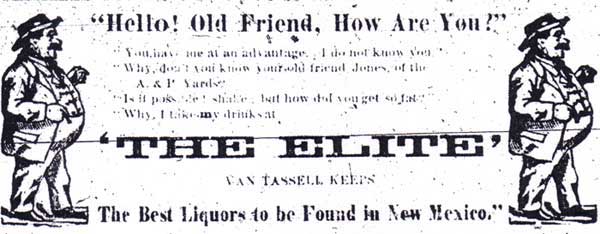
Albuquerque Evening Review, June 7, 1882
Billy Nuttles and Con Caddican, two of the most popular variety actors of Leadville, are in the city. They have some intention of leasing Smith & Snyder's opera house if they can make satisfactory arrangements, and if they succeed in this the boys will have some fine evenings of entertainment.
Albuquerque Morning Journal, June 8, 1882
Marshal Blonger is going to Santa Fe this morning. He has an eye on the deputy United States marshalship for this portion of New Mexico.
Albuquerque Evening Review, June 21, 1882
One of the Journal's prints, Will T. McReight, took occasion yesterday afternoon to exhibit to the people of the west end the depth of degradation to which a man can fall by indulging in a street fight with the woman upon the wages of whose debasement he lives. An outsider interfered in the matter and as is usual in such cases got the worst of it, the woman turning upon him with a volley of abuse and then bursting into tears.
Albuquerque Morning Journal, June 22, 1882
In a very scurrilous article, yesterday, the Review takes occasion, entirely uncalled for, to abuse one of the printers of the Journal office. The attack was very cowardly and unbecoming, for among those with whom he is acquainted, McCreight is well liked for his quiet, [...]ious habits. He was the first American journeyman printer in Albuquerque, and helped in getting out the first issue of the JOURNAL, and since his connection with this paper has never occasioned any cause for ill feeling among friends.
Albuquerque Evening Review, June 22, 1882
McReight and His Defender.
THE REVIEW never indulges in scurrility. It made no attack on McReight. It gave simply a very mild account of a disreputable and disgusting exhibition of the vileness and brutality of a man who happens to be employed in the Journal composing room. This was witnessed by a number of people in the west end, among whom was the president of the Journal Publishing company. To him the paper which is wanton enough to offend its decent readers by such a defense of rowdyism and uncleanness is referred for proof of THE REVIEW's accuracy, if any is desired. This is a newspaper and people who bring themselves as prominently before the public as did McReight may expect to see their names in print.
Albuquerque Evening Review, June 23, 1882
Cowardly Assault.
This afternoon about 1:30 W. F. Saunders, editor of THE REVIEW, was assaulted with a club by one, W. T. McReight, a typo, and knocked down and severely bruised. Saunders had been in Basye's jewelry store, and upon coming out walked up toward the Armijo House, and when near the White House Saloon observed three men sitting on a bench, just before he got to them one of the men, who proved to be McReight, jumped up in front of him and struck him with a large club which he carried in his hand. Saunders staggered under the blow, and McReight hit him again on the head, knocking him against a window, and breaking it. Saunders then caught the club and they struggled until some one took the club away from McReight, who immediately struck Saunders with his fist. Saunders was weak from loss of blood retreated into the White House, where McReight followed him, threw him down on the floor and struck him several times in the face with his fist, when Marshal Blonger appeared and took McReight away. The article which occasioned the attack was one giving an account of a fight between McReight and the woman with whom he has been living for some time, and who keeps a disreputable den in the west end.
THE REVIEW is a newspaper, and as such, it proposes to give news, of this or any other
character, and attacks of this sort will not change its policy in that regard one white. McReight will be arrested.
Albuquerque Morning Journal, June 24, 1882
W. T. McCreight, a printer, and W. F. Saunders, editor of the Review, had an altercation on Railroad avenue yesterday afternoon in front of the White House saloon. McCreight was the assaulting party, and gave the other a very severe pounding. Saunders provoked the assault by abusing McCreight, without any provocation, through his paper a day or two ago, and charging him with living upon the wages of a prostitute. McCreight was arrested and gave bonds for his appearance before Judge Sullivan today.
Albuquerque Evening Review, June 26, 1882
THE REVIEW has a word further to say on the subject of the assault made upon its editor by a man whose grievance was that he the truth told about him. This paper was established with the object of giving to Albuquerque what it needed, an honest fearless and truthful newspaper, in the most complete meaning of these words. How its efforts have been appreciated is shown by the rapidity with which its circulation has been increased in the city, as well and south and west of here; by the enlargement made necessary a month after its first issue, and by a second enlargement contemplated for the first part of next month. Newspaper readers and newspaper advertisers have endorsed its course. In the future THE REVIEW shall be what it has been; — devoted to the interests of Albuquerque, and courageous enough to give the news and point out abuse without regard to bullying or attempts to subsidize. Those who fear the truth may well look upon THE REVIEW as an enemy.
The case of the Territory against W. T. McReight was dismissed this afternoon by Justice Sullivan, on the ground of a variance between the complaint and the warrant.
Albuquerque Evening Review, June 28, 1882
The Territory Against McCreight.
On yesterday another warrant was sworn out against W. T. McCreight, who assaulted W. F. Saunders with a club on Friday last, Justice Sullivan having dismissed the first warrant on a technical point raised by counsel for defendant.
The warrant sworn out yesterday was placed in the hands of marshal Blonger for execution and was returnable at ten o'clock this morning. The witnesses for the territory were all present and after waiting for more than an hour and the defendant not appearing, district attorney Owen asked for the bond given for the defendant's appearance, in order it might be declared forfeited. The marshal said that he had taken no bond from McCreight and that T. Hughes, of the Journal, had said to him he would see that the defendant was present at the trial. Marshal Blonger then went out after McCreight and returned with Mr. Hughes, who stated that McCreight had sent him the message that he was ill and could not be present this morning. The trial was then postponed until half past three this afternoon.
Albuquerque Evening Review, June 29, 1882
TERRITORY VS. McCREIGHT
The Testimony and the Decision.
The case of the Territory vs. McCreight, charged with a murderous assault on W. F. Saunders, editor of THE REVIEW, which was postponed yesterday morning to half after three o'clock in the afternoon, was tried before Justice Sullivan at the latter hour, district attorney Owen appearing for the Territory. The testimony elicited was in substance as follows:
W. F. SAUNDERS,
Was the first witness put on the stand. He had just come out of Conley & Albright's drug store on the south side of Railroad Avenue and was going in the direction of the Armijo House. On reaching the White House he noticed two or three men sitting on a bench in front of it. Did not know any of them. A man, whom he afterwards identified as the defendant, jumped up and without a word struck him over the head with a stick. Could not identify stick. Was stunned by the blow and his mind was not entirely clear as to what happened afterwards. Remembered struggling with McCreight for possession of the stick, and being on the floor in the White House with McCreight on top of and beating him. Was disabled in the encounter. Could not yet use left eye. Could not tell whether first blow caused this injury. Had had no previous altercation with McCreight. On cross examination, stated that he was editor of THE REVIEW, had lived in Santa Fe before coming to Albuquerque and was from Virginia. No other facts other than those above set out were elicited.
S. T. ROSE,
A clerk at E. J. Post & Co's. He saw crowd across the street and ran over. Did not see beginning of the row. Saw two men struggling to get possession of a stick. Saunders seemed to be dazed and not to know what he was about. Someone came up and took stick from McCreight. In the struggle they got into the White House, when McCreight threw Saunders down and commenced beating him in the face with his fists. Marshal Blonger came in and separated them. Had to strike defendant on the arm with his club to effect his purpose.
A. N. WALKER,
who keeps books for T. J. Trask, was next. His testimony was corroborative of Rose's. He did not see the first blow. When he first saw the men, Saunders had hold upon one end of the stick and McCreight the other. Saunders seemed to be in a state of bewilderment. In the struggle Saunders was pushed through a large plate glass in the front window of their store. Saw the stick taken from McCreight. Saw the two men on the floor in the White House, with McCreight on top and pounding Saunders in the face. Some one in the crowd yelled out to take the man off, but others cried out "No, no make him sing out enough." Marshal Blonger a short time afterwards came in and pulled McCreight off. Could not tell how many blows were struck Saunders with the stick.
Stick used was very large, and seemed to be a heavy one.
- - WILSON,
a witness for the defense. Was sitting on the bench in front of the White House with defendant, when Saunders was approaching. McCreight remarked, "There comes the man that I want to see." He then struck at Saunders with a stick he had in his hand. Do not know whether the blow struck him. Do not think he was much injured.
W. T. McCREIGHT,
the defendant. Didn't know whether he struck Saunders on the arm or shoulder. Stick used was larger than the one he then held in his hand. (The stick he then had was about three feet long and about an inch and a quarter in diameter.) Had no intention of injuring him. On cross examination corrected himself and said he had no intention of injuring him for life. Didn't remember having made any threats against him.
District attorney Owen then asked that the defendant be sent on to the next grand jury for indictment, the evidence adduced having sustained the charge. On the other hand, however, T. F. Phelan, McCreight's lawyer, contended that at most it was a simple case of assault, and asked the court to so find. Justice Sullivan took the latter view of the case and fined McCreight $5 and costs. Several of the witnesses for the Territory were not present at the trial. One of them was out of the city and another one came in too late to give his testimony.
Albuquerque Morning Journal, July 1, 1882
Marshal Evans, of Coolidge, was telegraphed by Marshal Blonger, of this city, Wednesday, and requested to apprehend a man who was known to be in Coolidge, who is wanted here for swindling. Blonger took the next train for Coolidge, expecting to find the man in custody on his arrival. He was disappointed. Evans on receiving the dispatch made it his business to tell every one he met as well as the swindler himself. It is needless to say that when Marshal Blonger arrived he didn't find his man. Evans is either grossly incompetent for the position he holds or else he stands in with the thieves. It is hard to tell which view of the case would be the most charitable.
Albuquerque Evening Review, July 1, 1882
EVANS' ANSWER.
Defending Himself from the Charge of Incompetency and Neglect of Duty.
ALBUQUERQUE, July 1.
TO THE REVIEW:
On my arrival in the city I was astonished to see an article in the Journal charging me with incompetency and conspiring with thieves. I will not in detail enter into a reply to the biggest batch of falsehoods I ever saw crowded into the same space. I have telegraphed the operator [...] dispatches that passed between Marshal Blonger and me in reference to the arrest of a man wanted in Albuquerque but known to be in Coolidge, whom I was asked to apprehend. These dispatches I will publish to-morrow if the Journal will allow.
The man who was wanted was not in Coolidge when I received the message from Marshal Blonger, but arrived next morning. To make sure of the game I telegraphed an intelligible description of the man to Marshal Blonger and asked if I should arrest. Late in the day he responded, "Watch man; I will be there on the passenger. The Marshal and Justice Sullivan arrived on time; and were met by me and warned not to show themselves upon the streets, as if they did the man they were hunting would be among the first to learn of their arrival, either by seeing them himself or by being told by some of the gang who are always ready to sound the alarm when a pal is in danger. I was anxious to show appreciation of the visit and to render all the assistance in my power to so distinguished a person as the marshal of Albuquerque, and I am sorry he made the mistake of disregarding my injunction to keep ready until I could spot his game and put him on, since he seemed to be particularly anxious to make the arrest himself, rather than entrust it to me. Possibly he measured his fitness for the job in question by the difference in the size of the two places, Albuquerque and Coolidge.
The wanted man showed up in twenty minutes after the train that bore Marshal Blonger back to his own territory left. I telegraphed him that the man had made his appearance and asked him to return on the next train. He neither returned nor answered my telegram. Sometime afterwards Justice Hall telegraphed him, "Your man is here, Evans will arrest if you desire," or words to that effect. These are the facts. The charge that I told even my most intimate friends of the receipt of Marshal Blonger's telegram [..]r of standing in with thieves is such a gross misrepresentation that I decline to notice it.
J. A. EVANS
Deputy Sheriff at Coolidge.
Albuquerque Morning Journal, July 2, 1882
EVANS' RESPONSE.
He has Something to Say Concerning His Conducting at Coolidge.
ALBUQUERQUE, July 1.
EDITOR JOURNAL:
I beg space in your columns to make a brief response to an article which appeared in your issue to this morning, charging Marshal Evans, of Coolidge, with crookedness in the matter of Marshal Blonger versus the "Pale-faced Kid." I think the subjoined copies of telegrams, which passed between Blonger and Evans, will be all sufficient to convince a deceiving public of the utter falsity of the charges preferred by a man who neglected to append his signature, thus leaving the reader to infer that said scurrilous charge is an editorial.
Here are the telegrams:
ALBUQUERQUE, June 26, 1882.
To City Marshal, Coolidge:
Arrest a pale-faced, light-haired kid, about twenty years old, five feet seven inches high; on the train tonight going south, hold him and answer.
S. H. BLONGER
COOLIDGE, June 27, 1882.
To S. H. Blonger, Albuquerque:
Your man got off at the Atlantic and Pacific junction.
EVANS.
COOLIDGE, June 28, 1882.
To S. H. Blonger, Albuquerque:
Pale-faced, light-haired kid, about the age and height you described, arrived here this morning. He has on light suit, and dealt stud horse same side street of Zeiger's place. Do you want him?
J. O. EVANS
Deputy Sheriff
ALBUQUERQUE, June 28, 1882.
To J. O. EVANS, Coolidge, Deputy Sheriff.
Look out for man. I am coming on next train.
SAM BLONGER
COOLIDGE, June 29, 1882.
To Sam Blonger, Grants:
Your man has showed up. Return here on passenger tonight. Don't fail.
EVANS.
Deputy Sheriff.
COOLIDGE, June 29, 1882.
To Sam Blonger, Grants:
Your man has showed up. Return here on passenger tonight. Don't fail.
EVANS.
Deputy Sheriff.
COOLIDGE, June 30, 1882.
To Sam Blonger, Albuquerque:
Man here. Evans will arrest him if you want him,
JNO. B. HALL
After which I rest my case, without adding much that would make my case so clear that the most obtuse could not fail to see the injustice done me. In conclusion, if I were as uncharitable as the man who charges me with incompetency and standing in with thieves, I might hazard some opinions based on better authority than the accusations made against me, to the effect if a thorough investigation were made it would be found that people who live in glass houses should abstain from throwing stones.
Lastly, I employ no "scribende" to chronicle what I have to say, nor do I ever indulge in personalities without appending the cognomen bequeathed me by my good and honest parents.
J. A. EVANS
Deputy Sheriff, Coolidge.
Albuquerque Evening Review, July 3, 1882
Mr. [Tom] Hughes' appointment as postmaster at Albuquerque was confirmed Saturday, but he will hardly resume the reins of office for two weeks yet. He has so far decided upon but one of his clerks, N. B. Carden, who will return from Kansas to take the position.
Albuquerque Evening Review, July 6, 1882
JULY FOURTH!
The way it was celebrated in the Central City.
Immense Crowds of People Throng the Streets.
The Balloon Ascension, Horse Races, Base Ball, Etc., Etc.
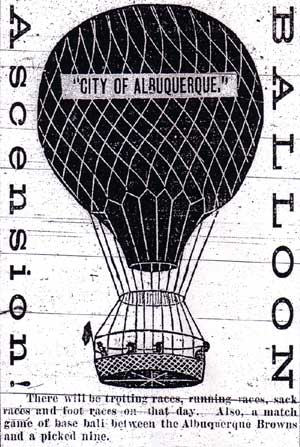
Early Tuesday morning the City of Albuquerque commenced to present a lively appearance. People flocked in from all directions. They came in wagons, on horseback, on foot and many more used burros as means of conveyance. Where all the people came from could not satisfactorily told, but they were here bent upon celebrating Independance day. The city itself was appropriately decorated and the stars and stripes swung from many a flag staff. Music floated upon the air from many places and the crack, crack of fire crackers could be heard in every direction. Saloon men did an immense business, and the efficient
POLICE FORCE.
which had been appointed for special duty succeeded in keeping those who drank too freely of the ardent from creating disturbances. There was no trouble during the entire day, and the quarrelsome ones, when they became too demonstrative, were taken care of without delay.
During the forenoon the crowd was centered on Second street, between Railroad and Gold avenues, to witness the inflation of Professor P.A. Van Tassel's balloon. The balloon has a capacity of thirty thousand cubic feet and
FILLED TOO SLOWLY.
to satisfy the impatient crowd. As the hour advertised for the ascension came and passed and still no signs of the aeronaut starting on his journey, the people became restless and a general buzz of dissatisfaction could be heard. They could not, or would not, understand the cause for the delay and many went so far as to assert that the voyage would not be made. It became apparent that the balloon would not be cast loose from its moorings before a late hour in the afternoon, and at about 1 o'clock a procession was formed and started for
THE FAIR GROUNDS.
to witness the races and other sports which had been made up. Every street car was crowded to its utmost capacity for the next two hours and the grounds were rapidly filled up...
Shortly after five o'clock word was telephoned to the old town that the balloon would start on its
AERIAL FLIGHT.
at 6:15 precisely. This announcement was made from the grand stand and the crowd again started for new town. Although the balloon was scarcely two-thirds full Professor Van Tassel decided to risk the trip rather than disappoint the people who had waited so long to witness the ascension. At the appointed time everything was in readiness and the bold navigator of the air stepped into the basket. It was found that the "City of Albuquerque" would not carry her captain with more than forty-five pounds of ballast, let alone any passengers, so she was turned loose with
ONLY HIM ON BOARD.
The balloon rose high above the house tops and moved slowly to the south, when it appeared to stop its lateral motion, and went straight up among the clouds. Another current of air was struck and the ship commenced to descend and landed safely
IN A CORN FIELD.
in the rear of the fair grounds. As soon as it was seen just where Prof. Van Tassel would alight, quite a number of men started for the place on horse-back, and a JOURNAL scribe obtained a conveyance in which to bring back the aeronaut and his balloon.
The professor was found, none the worse for his voyage, busily engaged in emptying the balloon of the gas. This was soon accomplished and the party with their ship safely loaded started for the new town arriving at the starting point at 9 o'clock.
A GRAND OVATION.
was awaiting the party at the Elite and many and loud were the expressions of congratulations with which Van was greeted. All united in saying that the ascension was a success in every sense of the word.
NOTES.
Just as the balloon was leaving its moorings, Professor Van Tassel emptied a bag of sand, which struck one of the spectators on the head, completely covering him.
Unknown
State's first manned balloon lifted off in 1882
from Albuquerque
By Scott Smallwood
Journal Staff Writer
On the morning of July 4, 1882, a bright, clear day in Albuquerque, crowds flocked to a vacant lot near Gold and Second to witness a bit of history.
There — more than two decades before the Wright brothers first flew their airplane on a North Carolina beach — New Mexicans had come to watch, as the newspaper ads had been proclaiming for weeks, "man's dominion over the very air he breathes." Professor Park A. Van Tassel, a tall, blond bartender, had recently purchased a balloon in California. As part of the Fourth of July festivities, he was scheduled to make the first manned balloon flight in New Mexico history.
C.W. Talbott, the gas works operator, had started filling the balloon at 5 p.m. the day before. On the morning of the Fourth of July, he still was filling it.
Christened "The City of Albuquerque," the 30,000-cubic-foot balloon was made of goldbeater's skin, a fabric made from the intestines of cattle. A net of hemp rope held the balloon to a wicker gondola. The launch, with Van Tassel and newspaper reporter John Moore as his passenger, was scheduled for 10 a.m.
The crowd, numbered in the thousands by local reporters, gathered early. Impatiently, they waited. And waited some more. The appointed time came and went, and still the balloon would not fill. Some thought the delay was a ploy by saloon owners to prevent the crowds from fleeing to Fourth of July celebrations in Old Town. Murmurs that the flight would never happen rippled through the crowd.
Albuquerque Morning Journal, July 8, 1882
S. H. Blonger, the city marshal, leaves this morning for Kansas City to be absent about ten days.
Albuquerque Evening Review, July 10, 1882
Sam H. Blonger and Lou Blonger were yesterday discharged from the positions of deputy sheriffs by Sheriff Perfecto Armijo. Sam Blonger is now on his way east, and Lou Blonger yesterday turned over the keys to the jail to the sheriff. Equipulo Romero, Corenlio [Cornelius] Murphy and Archie Hilton now compose the number of deputy sheriffs with the addition of C. T. Priest, who has just been appointed to one of the vacant positions.
Albuquerque Morning Journal, July 11, 1882
Changing Marshals.
Sheriff Armijo yesterday revoked the appointment of S. H. Blonger as deputy sheriff. Archie Hilton is to act as city marshal of new town in his stead, while Murphy and Romero will continue on the force as police men. No reason for the change has been given. Whatever else may be said of Sam Blonger, he has made the best marshal Albuquerque has ever had. The position is one in which it is impossible for any man to give universal satisfaction, and no one who holds it should expect to do so. If Archie Hilton does near as well as his predecessor, he will meet with the approval of the great majority of the better class of citizens. For a long time Hilton has acted as marshal in old town, and so far as can be learned has given satisfaction. That he will do the same in his new position is the earnest wish of the JOURNAL.
Albuquerque Morning Journal, July 13, 1882
Con Caddigan was yesterday appointed deputy sheriff. He will be on the police force in new town.
Albuquerque Morning Journal, July 13, 1882
Gaseous Greene.
Recent issues of the New Mexican prove that its manager is a miserable whelp, who does not understand the amenities of life, or the courtesies of journalism. Sent down to this territory by his owners in Kansas, he occupies his time in defaming those who would be his friends. His recent attacks on Tom Hughes, one of the stockholders of this paper, are without any foundation, undeserved, and will be fully resented. When Mr. Greene says that Hughes tried to blackmail the Palace, or any other hotel in Santa Fe, he willfully and knowingly lies.
Albuquerque Morning Journal, July 18, 1882
The Marshalship.
S. H. Blonger returned from Kansas City Sunday night, having stopped off at La Junta, and visited Pueblo on his way back. Immediately after his arrival he sought Sheriff Armijo and had a talk with him, regarding the marshalship. The sheriff told him of the turn affairs had taken as soon as he left for the east, and he said that he took the course he did only as a temporary measure and to quite the complaints which were being made against the absent marshal.
The sheriff authorized the JOURNAL to state that he offered to reinstate Mr. Blonger in his old position, but that offer was declined with thanks by that gentleman. The fact of the matter is that Mr. Blonger does not care to have the place while there is any opposition to him. It is supported by voluntary subscriptions and unless every one contributes the place is not worth having.
The last number of the Albuquerque Daily Journal comes to us enlarged into an eight column paper, the third enlargement in nine months. The Journal is ably edited by W. S. Burke, a well-known Leavenworth newspaper man for many years, and all his old Kansas friends will be glad to hear of this indication of his prosperity. — Leavenworth Standard
Albuquerque Morning Journal, July 27, 1882
THE NAIL CLINCHED.
A Portion of the Jewelry Which was Stolen From Howe's Jewelry Store Recovered.
Sufficient Evidence Against J. E. Goodman to Convict Him of the Crime.
Tuesday morning, July 18, M. E. Howe's jewelry store was burglarized and about $500 worth of jewelry besides $100 worth of clothing belonging to Frank Nichols was taken.
The burglar gained an entrance by removing a panel from the back door. The burglar left no clue behind him, and Mr. Howe had about made up his mind that his goods were lost and that the thief would be allowed to go unpunished to enjoy the fruits of his stealings, until the arrest of J. E. Goodman on suspicion was announced. Evidence has now been obtained and it is very likely that he will plead guilty.
A day or two before Goodman was arrested suspicion was directed toward him, and Lou Blonger sent a man to him asking about the stolen jewelry and offering to buy it. He fell into the trap and it was ascertained beyond a doubt that he was implicated in the burglary, but before any positive evidence could be obtained he became suspicious of Blonger and refused to compromise himself further. He was arrested Monday by Judge Sullivan and locked up.
Sullivan and Blonger put their heads together Tuesday and in the evening Goodman was taken from the jail and induced by Blonger to go with him and show the hiding place of the jewelry. A small portion of the stolen goods was brought to light from an old adobe house in the northern outskirts of the city. The remainder Goodman has disposed of but just how he refused to state.
The jewelry which was found was returned to M. E. Howe yesterday and its value found to be $89.75. There is but little hope of any more being recovered. Goodman will have his examination to-day. He did the work without the aid of accomplices and had he kept sober, would never have been detected.
Albuquerque Morning Journal, July 28, 1882
Quite a number of prominent business men and others think that Sam Blonger should be reinstated in the office of marshal and they are taking actions with that end in view. Blonger, while marshal, made an excellent officer and the interests of the town would be furthered if he was reappointed.
Albuquerque Morning Journal, August 3, 1882
A petition was circulated yesterday and signed by nearly every business man in town, asking Sheriff Armijo to appoint S. H. Blonger as a deputy sheriff and reinstate him in the position of marshal. It is hoped that the sheriff will grant the prayer of the petitioners. Mr. Blonger makes an excellent officer and will do good work if given the position.
Albuquerque Morning Journal, August 6, 1882
The petition which was so numerously signed by the principal business men of the town asking for the reappointment of S. H. Blonger to the position of marshal was presented to the sheriff yesterday and he refused to grant the prayer of the petitioners.
Albuquerque Evening Review, August 7, 1882
The petition asking the reappointment of S. H. Blonger as deputy sheriff of Bernalillo county and marshal of the west end has been presented to Sheriff Perfecto Armijo. The sheriff stated that he had considered the whole matter of Blonger's connection with the police force before he removed that officer, and that as no reason had been presented to him to change the conclusion at which he had then arrived, he could not grant the request.
Albuquerque Morning Journal, August 8, 1882
Prof. P. A. Van Tassell has returned from Las Vegas, having made arrangements for a balloon ascension there about August 15th. Las Vegas merchants subscribed liberally.
Con Caddigan is on deck again with his street cleaning brigade. It's hard to tell what would become of us if it were not for our very efficient marshal. He should have the thanks and support of every citizen.
Albuquerque Evening Review August 9, 1882
Virgil Earp, some time since a temporary citizen of Albuquerque, and withal a much more peaceable man than people would imagine one of his name to be, went to California and was one of the gamblers raided in San Francisco the other day. Fourteen hundred dollars and a faro lay out were found in his room.
NOTE: The writer was mistaken — Virgil Earp was not among the group that made its way to Albuquerque.
Albuquerque Morning Journal, August 16, 1882
VAN'S VENTURE.
The Aeronauts Balloon Bursts Before It Is Inflated.
Yesterday was the day that P. A. Van Tassell, of this city, was to make his balloon ascension from Las Vegas. His scheme proved unfortunate as the following from yesterday morning's Las Vegas Gazette will show: "The work of filling the balloon commenced at 9:30 a.m. and went forward nicely until all the available gas was used. The valves were then closed to await the manufacture of more gas. The balloon was about half inflated and contained 16,000 feet of gas. It rolled and tossed about at every breeze like some huge sea serpent, but was held steadily in its place by the sand bags and other fastenings. About 3 o'clock a dark rain cloud was noticed in the north, which betokened evil to the balloon. Its managers anxiously watched the movements of the cloud until 4 o'clock when a strong gale of wind swept down over the ill-fated airship, which sprnag into the air like a rubber ball, carrying with it all its moorings. She fell against the east side park fence, cutting a number of holes in the canvas. In a moment the gas had escaped and the entire work of the day was lost. It was the intention of Mr. Van Tassel to let the balloon rest until night and then complete the work of inflation. This programme, however, was suddenly thwarted and the work of repairing had to be commenced. The affair is a very unfortunate one, both for Prof. Van Tassel and for the people who expected to witness the ascension to-day.
Albuquerque Morning Journal, August 18, 1882
NO GO.
Van Tassell's Balloon Refuses to Leave the Earth in Las Vegas.
The Las Vegas Gazette of yesterday morning has the following to say concerning Van Tassell and his balloon:
"Professor Van Tassell yesterday made strenuous efforts to ride the air with his ship, but did not succeed in getting it up to any great height. The conditions seemed to be against him. Several times he got started, but each time came down in a short distance and pulled the air vessel back to the place of beginning. A lare crowd of spectators were kept interested in the efforts to fly away until near night. The balloon is full of gas, and she looks like she ought to move off majestically, but she don't. It is likely that one great trouble is the altitude of this place, which necessarily causes a light and thin atmosphere. Balloons in the states could soar a mile high and then not reach the starting point of this one. Prof. Van Tassell made a successful ascent at Albuquerque, but there he had the advantage of a thousand feet over this place. Ordinary illuminating gas is too nearly the same weight as our atmosphere to be a perfectly reliable medium for balloon ascensions. It would have to be very pure to be sufficiently light. The professor will make another attempt this morning to get his balloon in motion in the air."
The attempt was made again yesterday but proved a failure and Van gave up the project, having learned by experience that it is impracticable to make balloon ascensions from altitudes as high as Las Vegas. It is said that Van Tassell will lose nothing by his venture, as the people who subscribed to pay him for making the ascension will not refuse to donate their subcriptions as the failure was no fault of the aeronaut.
Albuquerque Morning Journal, August 22, 1882
Smith, of the varieties, and Sam Blonger had trouble Sunday night. No human bones were broken, but the bones of an umbrella were used up over the head of the showman.
Tony Neis talks of establishing the headquarters of the Rocky Mountain Detective Association in Albuquerque. He is now here making the preliminary arrangements.
Albuquerque Morning Journal, August 23, 1882
Tony Neis has already secured $150 to his subscription to assist him in establishing an agency of the Rocky Mountain Detective Association in this city. Sam Blonger is interested in the project, and will circulate the subscription to-day.
Albuquerque Morning Journal, August 26, 1882
Tony Neis, of the detective agency, has his office in the Harrison building.
Tony's Card.
As I intend locating permanently in Albuquerque for the purpose of organizing a detective agency I wish to state that the agents employed by me are fully competent and thoroughly versed in the business, and that I will personally be responsible for any of their acts while acting under my instructions. The agency here is in connection with that of Denver, and as heretofore I have given perfect satisfaction so will I in the future do my duty without fear or malice, nor will I show partiality to anyone. Trusting that my services will be appreciated by the law-abiding citizens of Albuquerque, I am respectfully,
TONY NEIS,
Chief of the Rocky Mountain Detective agency for the Territory of New Mexico.
Albuquerque Morning Journal, September 2, 1882
S. H. Blonger, who for a long time acceptably filled the position of marshal of New Albuquerque, is about to leave here for Prescott, Arizona, where he expects to go into the hotel business. Sam is an old hotel man, having for four years run a first-class hostlery in one of the principal towns in Iowa. His many friends in Albuquerque wish him nothing but success in his new venture, and Prescott people can depend upon it that he will keep a good house.
Albuquerque Evening Review, September 6, 1882
S. H. Blonger has gone to Prescott.
Albuquerque Morning Journal, September 7, 1882
S. H. Blonger started for Prescott, Arizona, yesterday morning. He expects to engage in the hotel business there.
Albuquerque Morning Journal, Sept. 12, 1882
A disreputable fight occurred Sunday morning in the opium den near the corner of Fourth street and Railroad avenue between a gambler and a disreputable woman. The woman proved herself to be the best man. These hop joints are becoming the worst kind of nuisances, and some means should be devised to remove them, or at least to keep them orderly.
Lou Blonger and P. A. Van Tassell
w[...] row in
a[...] yesterday
m[...] Van Tassel [...] worst of
[...] Blonger was arrest-
ed [...] action
of [...] He gave bonds in
the [...] for his appearance.
Albuquerque Evening Review, Sept. 12, 1882
IN A BAGNIO.
Lou Blonger assaults Park Van Tassel and Will Roast on the Legal Gridiron
Early this morning a party of three men, Lou Blonger and Park Van Tassel being two of them, went on a sightseeing expedition and in the course of their rambles reached that unsavory portion of Fourth street, north of Railroad avenue, occupied for the most part by houses which sell virtue by retail. One of them, kept by Blonger's woman, the trio entered, and began to amuse themselves, Van Tassel and the woman commencing a jocular conversation. Some remark used by Van Tassel angered Blonger, who without warning brought down his heavy stick on the aeronaut's head, following this blow by another and a heavier one with a long 45 revolver, which he drew immediately, in the same place. Springing back he then cocked the gun and threw it down on Van Tassel, with the exclamation.
"You s— of a b—, you can't talk to my woman in that way."
Van Tassel had jumped up when struck the first time, but the second blow stunned him and he fell to the floor. Blonger attempted no further violence, and the wounded man was taken to the office of a physician where his wounds were dressed.
This morning a warrant was issued for Blonger's arrest on the charge of assault with intent to kill. He was arrested, waived examination and was [held?] over in the sum of 3500 to appear at the October [district court?].
NOTE: "Blonger's woman," otherwise unidentified, would appear to be a perfect match for the notorious Kitty Blonger.
Our first encounter with Van Tassel was in transcribing this article. We blithely skipped over the word "aeronaut," thinking it just LOOKED like it said "aeronaut."
Albuquerque Morning Journal, September 14, 1882
S. H. Blonger returned from Prescott yesterday afternoon. He thinks that place is a boomer, and he will probably return and locate.
Albuquerque Morning Journal, September 16, 1882
Toney Neis and Lou Blonger went down the road last night.
Albuquerque Morning Journal, October 14, 1882
Tony Neis, who has been absent from this city for over two weeks, is expected to arrive this evening. He has been after several criminals, who are wanted in this city, and has been successful at capturing two of them.
Albuquerque Morning Journal, November 2, 1882
Albuquerque is the headquarters of the Rocky Mountain Detective Association in New Mexico, but Albuquerque still has robberies and crime. Tony Neis will have to bestir himself to sustain his reputation as a terror to evil doers. — [New Mexican.]
Albuquerque Morning Journal, November 3, 1882
And Still They Come.
To The Editor:
I fully endorse the sentiment of the last issue of The Journal in reference to the manner that affairs are conducted by those in power in Albuquerque. It has become a matter of comment throughout the whole country that the gang run the town. The communication of Santiago Baca has the true ring. The time has come when hold-ups and thieves must take a back seat. The experience of this country is the same as all new countries, the rough and cheeky scoundrels take precedence in the control of public affairs, and hold on until they are literally driven out by the better element of society. I trust the good work begun by the citizens of Albuquerque will be carried out to the utmost, and that they will not flag in their efforts until the gang are forced to retire and earn an honest livelihood.
SCRIBENDE.
Albuquerque Evening Review, November 4, 1882
Santiago Baca went out this morning, with quite a large crowd, on an electioneering trip. Among the party were Judge McComas, District Attorney Owen, Johnny Campbell, Lou Blonger, and a large number of Americans and Mexicans. The procession was headed by a black wagon drawn by four black horses, and a great many persons, seeing it from a distance, thought it was a funeral procession.
Albuquerque Morning Journal, November 5, 1882
TO THE PUBLIC.
I have been importuned by a large number of persons for appointment to places on the police force in case of my election. I have said to all such, and desire to say in this public manner to the people of the city, that my action shall be governed in all such cases by the wishes of the business men of Albuquerque. I shall not appoint any man to the office of city marshal who does not bring the endorsement of a majority of the merchants and business men of this cit, and shall not refuse to appoint any man who may come thus endorsed. The office of city marshal is one of great importance to the people of the city, and it shall be my aim to appoint only men as shall be recommended and endorsed by a majority of the people most interested.
SANTIAGO BACA.
Albuquerque Evening Review, November 7, 1882
Lou Blonger challenged two votes by mistake this morning, the men whom he had intended to challenge having already deposited their ballots.
Albuquerque Evening Review, November 8, 1882
The latest news from the quondam Albuquerqueans, the Earp crowd, is that Wyatt, Warren and Virgil Earp are in San Francisco, engaged in dealing faro. Texas Jack is in Colorado, Doc Holliday in Leadville, McMasters and Johnson in Mexico, and Tipton in the Gunnison country.
Albuquerque Evening Review, December 2, 1882
CONFIDENCE MEN CAUGHT.
A Wholesale Arrest of Alleged Confidence Men Creates a Sensation.
An Albuquerque Office is Among the Rest.
This morning Chief Howe, assisted by his men, arrested John P. Thornton, Barney Quinne, Billy Nuttall, Sam Houston and Con Caddagan on complaint of Henry Griffiths, who charges them with grand larceny. He claims that they enticed him into a saloon and get a certificate of deposit on the Central Bank for three hundred and forty dollars and a ten dollar note. The trial is now taking place before Judge Bell in the court house, west end.
The chief witness, Henry Griffiths, who is a Scotchman by birth, has been in town but a short time, having come in from the front and deposited his savings, amount to $340, in the Central bank, for which he received a certificate of deposit. He says that Barney Quinn made his acquaintance and introduced him to Billy Nuttall, and told him that Nuttall was a mining expert. He also introduced him to Sam Houston, alias Hopkins, alias Brown, was a mining speculator who had just sold a mine for $17,000. In the meantime they were all taking a drink, and Griffiths got pretty full, when they went into a saloon and commenced shaking dice for drinks. They threw the dice so that the top and bottom of the dice made it count up twenty-one every time. Griffiths thinking that it was chance, bet ten dollars that it could not be done again, and lost, whereupon, a teamster standing near offered to be they could not throw twenty-one again, when one of the party turned to Griffiths and asked him to let him have the certificate of deposit to bet against the teamster's pile, so Griffiths pulled it out, the dice were thrown, and the teamster won; the certificate was passed to him, and almost before the victim knew it, the man had disappeared, certificate and all. Griffiths was condoled with by his companions, who guaranteed to get the certificate back before twenty-four hours, and then quieted him for that night.
The next morning was Thanksgiving day, and the Central bank was closed when Con Caddagan, accompanied by the teamster, knocked at the door. Mr. W. K. P. Wislon, the cashier, was sitting inside and went to the door to see who was knocking. Seeing Caddagan and the teamster he let them in. Caddagan asked him to pay the amount the certificate called for to the man, saying that he had to go off on the train in a hurry and needed the money. This Mr. Wilson refused to do, and after some words Caddagan and the teamster went out.
Griffiths sobered up that morning and told Chief Howe about it, who immediately started to work up the case, with the above result. The officers think that Thornton is the man who personated the teamster.
Billy Nuttall and Sam Houston are sporting men, Barney Quinn was formerly proprietor of a saloon knows as the Sportsman's Headquarters, and Con Caddagan is constable of precinct number twelve and has been on the police force for some time. Thornton is also a sporting man. Caddagan is on the stand as THE REVIEW goes to press.
Albuquerque Morning Journal, December 3, 1882
AFTER THE BUNKOS.
A Raid Made on the Confidence Men Yesterday.
Con Caddigan Arrested But is Honorably Acquitted of the Charge.
The Four Others Held to Bail in the Sum of $3000 Each.
Extreme Excitement Over the Affair Among the Sporting Fraternity.
On Friday evening Judge Bell, who had just returned from Socorro, was called upon by District Attorney Owen, and a Welshman by the name of Griffiths. The latter, who arrived in this city sometime during last week, made an affidavit that he had been swindled out of ten dollars in money and a certificate of deposit, payable at the Central Bank, and amounting to $345. Judge Bell immediately issued a bench warrant for the arrest of five men, who names appeared in the warrants as "One Brown, first name unknown, and one unknown man, as principals," and William Nuttall, Barney Quinn, and Con Caddigan as accessories.
Yesterday morning Chief Howe, assisted by several officers, arrested the parties named in the warrant, and they were all taken to the marshal's headquarters.
Judge Bell was at once notified of the result, and ordered that the prisoners be taken to the court house, in the old town.
Upon taking his seat, Judge Bell inquired whether or not the defendants desired an examination, to which they all responded in the affirmative.
The first witness called was the prosecutor himself, Henry Griffiths, who testified that he came to this city on the evening of November 22, from Chino Valley, on the line of the Atlantic & Pacific Railroad.
The witness then went on to state in a very straightforward way, the whole circumstance attending the loss of his money.
He stated that he met Barney Quinn at John Boyle's restaurant, where witness was stopping, that Barney asked him to take a stroll, and that they went up street, where they took several drinks, that they then returned to Boyle's, and that he agreed to meet Barney at 8 o'clock in the evening. They did meet and took a walk down town, and stopped in at a saloon, where they met a man by the name of Brown and an old teamster whose named Griffiths did not know. Brown and Griffiths got to throwing dice and induced, after much talking, the Welshman to take a hand in the game. He did so to the extent of about $350. Nuttall came into the saloon just after the game was finished, and just in time to see the teamster leave with the roll. The witness went next morning and stopped payment of the draft, by stating the case to Mr. Wilson, of the bank.
All the defendants took the stand in their own behalf, and each described the portion allotted to him, so far as any criminality was concerned.
Thornton acknowledged that he had the check, but denied that he had received it any but a perfectly legitimate way.
After a cross-examination of all witnesses by Judge Bell, and the district attorney, the court rendered a decision, discharging Caddigan from custody and holding the others in $3000 bail.
All the defendants were busy last evening procuring bail.
Albuquerque Evening Review, December 4, 1882
The trial of the confidence gang for robbing a man named Henry Griffiths of $350 was concluded Saturday afternoon, Judge Bell discharging Con Caddagan for want of sufficient evidence, and holding the other four in $3,000 bail. John Thornton and Barney Quinn succeeded in raising the required amount, but Billy Nuttall and Sam Houston had to go to jail.
Albuquerque Morning Journal, December 5, 1882
The arrest of the confidence men last Saturday is the principal topic of conversation on the streets. It is said that the only men who got away with any of the winnings of the game have escaped and left town, and all those under arrest made by the operation was a great deal of trouble for themselves.
Albuquerque Evening Review, December 5, 1882
There is strong enough decent public opinion in Albuquerque to sustain a courageous and honest police force in the discharge of its duty. If it is necessary, that public opinion will become public resolution.
Albuquerque Evening Review, December 12, 1882
THE REVIEW boys are indebted to W. T. McCreight, the new proprietor of the opera house saloon, for a supply of cold beer, sent over this afternoon.
NOTE: According to information available on the Internet, McCreight had been a professional baseball player in St. Louis and after reaching Albuquerque
in 1880, started the town's first baseball team. He apparently later was a co-owner of the
Albuquerque Citizen with Tom Hughes.
W. H. Cline & Co. swore out a warrant last night for the arrest of Toney Neis, the well-known detective, on the charge of slander, it being claimed that he stated on the street that "Cline & Co." were running a bunko shop, and their business was swindling and that he would pull the establishment at the first opportunity. He was arrested by Con Caddigan and gave bonds for his appearance before Justice Sullivan.
Albuquerque Evening Review, January 9, 1883
Con Caddagan went up to Bernalillo this morning with a warrant for the arrest of John Spillman, who is under indictment of the grand jury for assault with intent to kill, and who is before the contest board as a witness for the Pereas.
Albuquerque Morning Journal, February 6, 1883
Con Caddagan passed through the city last night on his way to Chihuahua, Old Mexico, where he will open a theatre. He has engaged all the performers, who will start for Chihuahua to-morrow night. He says there's millions in it.
Albuquerque Evening Review, February 6, 1883
Con Caddagan came in last evening from Pueblo, where he has been to secure talent for his variety theater in Chihuahua. He leaves to-night for old Mexico.
Albuquerque Morning Journal, February 7, 1883
Con Caddagan started for Chihuahua again last night. This time he made sure of his dog which he left behind night before last and was compelled to return for him yesterday morning.
Albuquerque Morning Journal, May 5, 1883
Ex-marshal S. H. Blonger had a running horse, Sorrel Dan, entered at Pueblo, but the best he could do was second place.
Albuquerque Morning Journal, June 29, 1883
Sam Blonger shipped his racing horses to Santa Fe last evening on the emigrant train. Other turfmen now holding stock in Las Vegas will follow suit
to-day. — Gazette
And the Albuquerque trail goes cold.
Now, some occassional updates from later years
on some of the supporting cast....
Unknown Newspaper, July 26, 1884
Gold Brick Man Collared
A Tough Pair in Toils at St. Louis, Mo.
Clay Wilson and Con W. Caddigan, arrested at St. Louis July 1st with a lot of gambling implements and bunco material in their possession, are well known to the Western Detectives as smart confidence men and thieves. They are members of a gang that has worked Denver and Deadwood and the mining camps of Colorado and New Mexico, and have followed the Mexican Central road into Mexico. Harry Duval, or the "Texas Ranger," was the leader of the band, and Frank Pine, "Jumbo" Clifford, Tom Ashton, and Al Connors, all of whom are now working in the West, were under his orders, with Caddigan and Wilson.
Clay Wilson generally had his headquarters in Denver and Leadville. About two years ago with a companion, he swindled the son of a Leadville Bank President out of $25,000.00 by "gold brick," prepared according to the formula found in his room when arrested. He and Caddigan were afterwards arrested but escaped prosecution but returned part of the money to the victim. Wilson then went to Denver and turned several more confidence tricks, bringing himself into prominent police notoriety. He was a desperate gambler and became the rival of Jim Moon, a Denver sporting man who bore a hard character. Moon, when drunk one night, slapped Wilson in the face and threatened his life, driving him out of the Arcade Saloon, where they were. Wilson returned with a pistol, and standing behind the saloon folding door, emptied a revolver into Moon's body as he was drinking. He was tried and acquitted, but Moon's friend swore vengeance on him, and he left the State, going to Mexico for safety. He has not been heard of in Colorado since. But he has friends in Denver who will come to his aid in his St. Louis trouble.
Con Caddigan is a rascal of similar caliber than Wilson, and has been used by the bunco gang as a "stool pigeon."
He appeared as a confidence man first in Albuquerque, New Mexico, where the gang had their trans-continental rendezvous. Albuquerque was then a new town and the bunco men ran it with a high hand, electing as Justice of the Peace Dan Sullivan, one of their friends, and as Marshal and Constable Milton Yarberry, who was hanged last year, and Con Caddigan. The operation of these bunco men finally began to hurt the passenger traffic of the Santa Fe road, and the Company determined to drive them out of the territory. So when they cheated Henry Griffith, a Welsh miner, out of $75.00 through the top and bottom trick, Caddigan, Barney Quinn, Billy Knuttall, three of the confidence men, were arrested and put in jail to await indictment, escaping in a few days by the work of their companions outside who bribed the jailer. Caddigan then came to St. Louis and got a variety company which he took to Chihuahua. he played them for several weeks and then deserted them, taking all the money of the company with him. His arrest in St. Louis will afford his victims the liveliest satisfaction.
Washington Post, December 22, 1884
A Balloon Marriage Projected.
From the San Francisco Call
The largest balloon which has ever been built on this coast is at present being constructed under the supervision of P. A. Van Tassel, an experienced aeronaut, at the engine-house of the Sutter-street Railroad Company. Its foundation was laid at the Mechanics' Pavilion fifty-six days ago, the work having been continued ever since. It required eight seamstresses to sew it together in ten days. It is 110 feet in height, fifty-eight feet in diameter, and has a carrying capacity of 2,800 pounds. When inflated it will hold 85,000 feet of gas. It weighs 900 pounds, the basket alone weighing 150 pounds. It is made of cloth specially manufactured for balloons, and is very light, besides being extra strong. Mr. Van Tassell has made twenty-four successful ascensions, and feels confident that on the 30th instant, when he ascends from Central Park in this City, he will accomplish one of the longest trips ever made on this coast. He has crossed the Wahsatch mountains from Salt Lake, having traveled 142 miles in six hours and thirty-two minutes. He will take with him a young couple, who will be united in marriage during the aerial voyage, provide a priest or justice of the peace can be found who will be willing to risk his life on such a trip.
Unknown Deadwood, SD newspaper, 1884
Bill Nuttall, who conducted the Bella Union theater in the flush days of Deadwood, is said to be occupying private quarters in the Alberquerque, New Mexico, jail, charged with gambling. How the mighty have fallen.
Los Angeles Times, June 27, 1887
A FIZZLE.
Because Somebody Had Been Monkeying with the Pipe.
A Disappointed Crowd Inside and Out of the Grounds.
Revilings Loud and Deep Against the Man Who Shut Off the Gas with a Plug of Sand and Gravel — Silly Charges Against the "Chronicle."
About 4000 people gathered in and around the Sixth-street base-ball grounds yesterday to witness the ascension of Prof. Van Tassell in his monster balloon, and also to enjoy a very interesting game of base-ball between the Los Angeles Club and the San Luis Obispo nine. At six o'clock yesterday morning the gas was turned on through a four-inch pipe, and the managers were positive that the balloon would be inflated long before noon. Several hours after the gas was turned on, it was noticed that the monster airship was not filling as rapidly as she should, and the superintendent of the gas works was sent for. The management was about to give him a piece of its mind in true Examiner style, when some one discovered that the pipe where it was attached to the cloth conductor leading to the balloon had been plugged up with sand and rocks. This was a revelation that had not been anticipated and a general pow-wow was indulged in by all of the big men of the management. The Examiner managers were very profuse in their abuse of the wretch who had played such a joke on them, but they would not say openly whom they suspected. Outsiders were not at all backward in giving the Chronicle a blessing. They got right up and swore by all that was holy that the mysterious Chronicle man ought to be mobbed. A plumber and gasfitter was looked up, and two two-inch pipes were placed as soon as possible and the gas was again turned on. The balloon began to fill slowly, and the Examiner management announced to the immense crowd that had commenced to arrive at that time that the airship would go up as soon as the base-ball game had been played. The crowd which had paid its money to get inside took things good-naturedly, but the audience on the outside became very uneasy, especially when the balloon did not fill so rapidly as it should.
When the game was ended the balloon was not more than half full, and the management again had to make a humiliating announcement. The good-natured crowd was informed that the ascension would be made promptly at 7:30 o'clock, and the gatekeepers were instructed to hand each one of the audience a check, and they were dismissed. The excursionists were notified that their trains would not leave until 8 o'clock. As the people from the country took their deoarture they indulged in a good deal of complaint, and several of them hinted at mobbing the Examiner man in case the balloon did not go up at 7:30. When the thousands of people who had taken their places on the housetops and hills noticed the audience leaving the grounds they became thoroughly disgusted, and, could they have had their own way, the chances are that the Examiner management would have been mobbed without ceremony. As it was they all wended their way home, and strange as it may seem, no one returned to see the ascension at 7:30. The balloon, however, was sufficiently filled at 7 o'clock, but no one seemed to care to take a trip in the darkness at that hour, and it was decided to let the old ship cling to several hundred sandbags until 10 o'clock this morning, when the gates will be thrown open to the public, and every one who wishes to see the balloon cut loose will be admitted to the grounds, free of charge.
To make sure that there was not some "monkey business" about the four-inch pipe story, a TIMES reporter investigated the pipe, and was astonished to find that it had really been filled with small rocks and sand. This must have been done during the night, after the connections had been made, but before the gas had been turned on, for after that was done a watchman was presnt all the time. It is not known who could have an object in doing such a thing. No one, however, believes that the Chronicle would sanction such a thing.
Last night a police officer and one of Van Tassel's men were stationed in the grounds, so that there will be no doubt about the ascension this morning at 10 o'clock, as the balloon is all ready, and there is nothing further to be done, except for the persons who intend to make the ascension to step into the basket and cut the sandbags loose.
Los Angeles Times, July 27, 1888
THAT BIG JUMP.
Mrs. Van Tassel Interviewed by a San Francisco Reporter.
[San Francisco Examiner.]
It is no soft, yielding, timid shrinking wife that Prof. Van Tassell possesses.
It is unlikely that a woman who would deliberately launch herself from a balloon 6000 feet in the air and spring to the earth without being frightened would meekly get up in the morning and build a fire to please any husband. Particularly when she weighs 165 pounds and requires a 28-foot parachute to bring her safely to the ground.
On the Fourth of July Mrs. Van Tassell, escaping from the detective who had been set by the Chief of Police to prevent her ascent, mounted in her husband's balloon to a height over a mile above Los Angeles and then, without falter, launched herself out into the air and dropped.
The heroine of the long jump has returned to San Francisco. An Examiner reporter interviewed her at home on Turk street yesterday.
Mrs. Van Tassell is big, young, handsome and blonde.
Since she made the jump she has gained a commanding manner and a self-reliant carriage.
"It is only a question of nerve," said Mrs. Van Tassell, when asked about her exploit. "I made up my mind that I could jump from a balloon as well as Baldwin, and when I make up my mind to do a thing I do it. Don't I, Van?"
The Professor looked at the woman who wasn't afraid of a mile jump and meekly admitted that what she said was true.
"So, when we were over a clear place," continued the lady, "they opened the valve to hold the balloon stationary and give the 'chute a start to open a little, and then I said good-by and jumped. I had been warned that my arms would be jerked from their sockets and expected a tug, but though I dropped thirty feet like a shot before the parachute was well open, there was no shock, and I felt no great strain on my arms.
"I often dreamed of falling immense distances, and I wanted to see how it really was.
"I ain't exactly a bird nor an angel, but it's just about what I imagine the sensation of flying is. It was beautiful! Though I went through that 6000 feet in five and one-quarter minutes, I didn't seem to be going fast, and never lost my breath. I swung hundreds of feet one side and the other for the first 4000 feet, but after that I just floated down an incline to the ground, and alighted with no more shock than would be caused by jumping off a chair.
"I wasn't the least bit frightened from the start. One arm was strapped to the parachute, and there was a belt around my waist, so I could not fall away from the parachute."
"Did you do any thinking while you were falling?" asked the reporter.
"I only thought about my landing, whether I would drop on a big tree that was just under me, or on a house that I saw. I luckily missed both.
"I was anxious to get a reputation, and I did, and I expect to make a fortune by jumping from balloons. Don't I, Van?"
Prof. Van Tassell meekly acquiesced.
New York Times, November 24, 1889
AERONAUT VAN TASSEL LOST.
He Dropped Into The Pacific And Was Probably Eaten By Sharks.
SAN FRANCISCO, Nov. 23.—Prof. Van Tassel, an aeronaut, met a horrible death in Honolulu on the 16th inst. He made an ascension on that day, and on coming down in his parachute, he fell in the water and was never again seen.
The occasion was the King's birthday. There was a grand celebration, and the festivities were to conclude with an ascension and leap. Shortly before 3 o'clock Van Tassel entered his balloon alone, after all necessary preparations had been made. The conditions were favorable for his landing on the island, and when the balloon shot upward he shouted to his brothers that he would land not more than half a mile from the starting point. The balloon ascended steadily to the height of 1,000 feet, when it was caught by a breeze blowing seaward and carried over the water.
The aeronaut evidently saw that he must inevitably fall into the water, and those who were watching saw that he was hurriedly making preparations for the descent. Suddenly the parachute was let loose and the bag of gas shot up into the air. The parachute opened nicely, and the man descended gracefully into the water about two miles off shore. That is the last that has been seen of him. The steamer Zealandia was leaving the harbor at the time, and those on board saw Van Tassel fall in the water about a mile distant.
Two boats were immediately lowered, and were soon at the spot where the man was last seen. They could find no trace of him. The parachute had sunk in the water from the weight of its iron frame, and three or four monster white sharks were seen nearby swimming about. They followed the boats back to the steamer.
There seems no doubt that the sharks made away with Van Tassel. He was a daring swimmer, and under ordinary circumstances could not have drowned before the boats reached him. Van Tassel was well known throughout the United States, having made many successful ascensions and parachute descents. He was a native of New York, forty-three years old.
NOTE: The sharks did not in fact make away with the Professor. See last article.
FROM THE ISLANDS.
BALLOONIST VAN TASSEL KILLED.
The Zealandia reports that as she entered the harbor at Honolulu November 16th, Prof. Van Tassel, the balloonist, made an ascension from the shore and dropped from the balloon in a parachute. He fell into the ocean about two miles from shore and one mile from the steamer. He was seen no more, and it is supposed he was eaten by sharks. Van Tassel left San Francisco a few weeks ago for Honolulu and Australia, where he expected to give exhibitions.
The occasion was King Kalakaua's birthday. There was a grand celebration, and the festivities were to conclude with an ascension and parachute leap. Shortly before 3 o'clock Van Tassel entered his balloon alone. The balloon ascended steadily to the height of 1,000 feet, when it was caught by a breeze blowing seaward and carried over the water. Van Tassel hurriedly made preparations for descent. The parachute was let loose and the aeronaut descended into the water about two miles off shore. That was the last that has been seen of him. Two boats were immediately lowered from the Zealandia, but they could find no trace of him. The parachute had sunk into the water from the weight of its iron frame. There seems to be no doubt that sharks devoured him.
Van Tassel was a daring swimmer, and, under ordinary circumstances he could not have drowned before the boats reached him. The search for him or his body has been continued every day since the accident. In an interview concerning the reported death of her husband at Honolulu, said she did not believe the report correct, for the reason that a man named Joe Lawrence, from Albuquerque, N. M., was travelling with Van Tassel under the name of Van Tassel, and doing all the parachute work. Van Tassel has not taken a leap since the one at the cliff house, in San Francisco, because the balloon was considered too light to carry 225 pounds to a desired height. Lawrence could not swim, while Van Tassel was a good swimmer.
Los Angeles Times, May 27, 1911

No Posse Required to Keep Him Going.
With a bench warrant issued yesterday from Justice Summerfield's court for C. W. Caddigan, and with a Minnesota extradition warrant for him still wholly unsatisfied, the local police now believe that one of the cleverest confidence men of an old and rapidly vanishing school has escaped the arm of the law as lightly as a child at play might break a thread.
Added to the surprise of his attorneys and the uneasiness of his bondsmen was the chagrin of the officers when Caddigan, whose real name is Thomas Moore, and whose other alias is John Armstrong, failed to appear in court yesterday morning to face witnesses of the State in the case of E. W. Chaffee, who, in behalf of his father, H. F. Chaffee, has made a requisition for Caddigan to Minneapolis, on a charge of buncoing the older Chaffee out of $25,000 in 1909.
Young Chaffee alleged that his father paid this sum to Caddigan, then parading under the name of John Armstrong, for two nicely-pressed gold bricks in good condition as to glitter and heft.
Caddigan, who is seventy years of age and who got local recognition as a mining man of means, put himself up as sadly misrepresented in the present case, and as eager to satisfy the court that he was not the man desired. He appeared in court several times before the arrival of the State's witness, but at the showdown he was not there. If his absence from the court extends over a period of twenty days, his $50,000 bond, signed by Guy K. Woodward and D. O'Donnel will stand forfeited.
Detectives Jones and Boyd, who have handled the case, stated last night that Caddigan's history is as ancient as unique. He was at one time Town Marshal of Albuquerque, but departed hot-foot from the city in 1883 with an alert vigilance committee close behind, punctuating their warnings never to return with arguments more emphatic than words.
Caddigan, it is alleged, had turned some crooked jobs and the hustling western camp preferred his room to his company. He was associated in the New Mexico City with several notorious characters, two of them being the famous Blonger brothers, and one of them Soapy Smith, the great confidence shark, who was perhaps less clever, but a deal more real than J. Rufus Wallingford.
Soapy's death in Alaska, the officers say, removed the last of that old gang of peerless fishers for suckers from the scenes of mortal avarice, with the exception of Caddigan.
NOTE: He strangely forgets about Lou, who is going gangbusters in 1911.
Caddigan's first claim to local distinction was his arrest here in February in connection with X. F. Holler, charged with attempting to swindle Mrs. Ida Kendall out of a large sum by negotiating for the sale of a gold brick.
NOTE: This is before Lou's arrest by ten years, and yet the Blonger Bros. are apparently "famous" as far as Los Angeles.
New York Times, October 26, 1930
CAPTAIN PARKS VAN TASSEL.
Parachute Jumper of '70s Dies of Heart Disease at 78.
OAKLAND, Cal., Oct. 25 (AP). —
Captain Parks Van Tassel, who was a daredevil parachute jumper in the early '70s, survived the hazards of his calling to die here yesterday of heart disease at the age of 78.
The pioneer balloonist and jumper made his first leap at Kansas City in a parachute he constructed from a diagram he found in a dictionary.
Captain Van Tassel had jumped from balloons in nearly every country in the world, his experiences covering more than half a century. His wife was one of the first women to use a parachute, making her first leap at Los Angeles on July 4, 1882, amid great local excitement and against the opposition of the Chief of Police, but with approval of the Mayor. The Captain made his longest balloon flight in 1883, at Salt Lake City, staying aloft six hours and forty-five minutes and traveling 300 miles.
|