In my last post, I found that Lou Blonger’s first wife, whom we had only known as Emma K. Loring, was living in Oakland, California, in 1938. To summarize the documentary evidence:
- Lou Blonger stated that he married Emma Loring in San Francisco in either 1882 or 1884. He divorced her in Colorado in 1889.
- In 1938, a woman named Emma K. Boies of 631 Ninth St. in Oakland, inquired with the California State Archives about the marriage of Louis Blouger (evidently a misreading of her handwriting) and Emma Kate Loring.
- A woman named Katherine Blonger, who listed her father as James Loring, married James Claude Boies in San Francisco in 1923.
- Claude and Katherine Boies lived in Martinez, California, at the time of the 1930 census.
- Claude Boies was the head of household at 630 Ninth St. in Oakland from 1934 and 1944.
- In 1923, a woman identifying herself as Katherine Russell of Martinez, California, claiming to be the first wife of Lou Blonger, wrote to the Denver district attorney in an attempt to communicate with the bunko king.
Based on this evidence, I was quite certain that Emma K. Loring and Katherine Boies were the same person.
I was not as certain about her parentage. I identified a possible, even likely, set of parents in Iowa, but there was not enough evidence to prove the connection beyond a reasonable doubt. Today, we look at some new evidence that moves Emma’s story forward.
The Loring Family
On her marriage license application, Katherine Blonger gave her birth place as Iowa and her parents as John and Carrie Loring. Some of the Katherine’s other answers were problematic, but disregarding those for the time being, I was able to locate a family in Indianola, Iowa, that fit all the criteria. Enumerated in the 1870 census, Emma K. Loring was 9 years old and the eldest of four sisters.
Their father, John Lee Loring, died in 1874. Luckily for us, he was a Civil War veteran, and his widow, Carrie (or Caroline), submitted an application for his military pension. Among various genealogical items, the application contained the birth dates of Emma (Sept. 7, 1862), her sisters Ella, Jennie, and Lena, and a previously unknown sister named Susie, who was born in 1873.
Sad to say, Carrie never got her money, although she kept trying well after she had lost her second husband, Henry Gregory, and been abandoned by a third, a previously unidentified man named James George. When she sent her last, futile inquiry to the pension administration in 1910, Carrie George was living in Los Angeles.
These new insights — Carrie’s final surname and her relocation to California — helped me track down her death on February 23, 1918. That led to her obituary in the San Diego Sun, which included a surprising clue that provides irrefutable proof that Carrie’s daughter, Emma Loring, and Katherine Boies of Oakland, California, were one and the same.
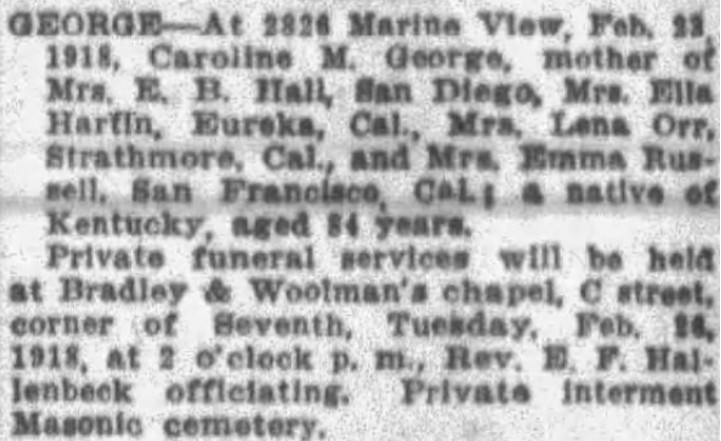
Did you spot it? In 1918, Emma was using the surname Russell — just as she did when she wrote to the Denver district attorney (as Katherine Russell) in 1923.
Emma Katherine Loring Blonger Russell(?) Boies was the daughter of John and Caroline Loring of Indianola, Iowa.
(And in case you’re wondering, Mrs. E. B. Hall was Emma’s sister, Jennie.)
Who was Emma?
With Emma’s parentage now certain, we can provide some details from John Loring’s pension file, and some newspaper items from places mentioned in it.
Sometime after the 1870 census was taken, the Loring family moved from Iowa to Wichita, Kansas. John died there on January 13, 1875, in his meat shop. A newspaper said he had heart trouble, but according to Carrie’s application, her husband’s death was from “disease incurred in service.” She was unable to provide any evidence of the disease to the pension bureau, and that was the main reason Carrie never received any government assistance.
After John’s passing, Carrie lost the family’s house in Wichita to foreclosure and relocated to Great Bend, Kansas, where she opened a boarding house in 1876. That venture appears to have fallen through, because a couple of years later the Great Bend newspaper reported that Carrie had moved to nearby Hutchinson, where she was “landlady at the Commercial Hotel.”
In Hutchinson, her daughter Emma found work as a type compositor for the Interior, the local newspaper. That was an unusual job for a 15-year-old girl, a fact noted by the Interior and both papers in Great Bend.
In June of 1878, Carrie married Henry Gregory, a 50-year-old cattle herder. The two were enumerated in the 1880 census in Great Bend along with three of the Loring girls. For unexplained reasons, Jennie, who would have been 12, was not listed. Emma, meanwhile, had gone to Pueblo, Colorado, and married a man named John Thompson (on August 13, 1878), according to Carrie’s pension application. From Pueblo, it’s not hard to imagine Emma’s first encounter with Lou Blonger occurring in Georgetown, Colorado, where he ran a theater in 1879, or Leadville, where he lived in 1880, or even in Albuquerque, where Lou was a deputy sheriff in 1882.
Interestingly, Carrie was listed as a physician in the 1880 census. No further information on Carrie’s occupation has been found, since she does not appear in the census in 1900 or 1910. However, based on her correspondence with the pension board, she seems to have been an educated woman.
Open questions
There are still some important questions awaiting an answer.
I’d like to put a bow on the story of Emma/Katherine by finding out when she died and where she was buried. I’m assuming she had passed away by 1940, when her husband was recorded as a widower in the census. (He married again in 1943.) She probably died in Oakland, where she lived in 1938. My communication with the Alameda County Clerk has been delayed, but I hope to have an answer soon.
Carrie’s pension application raised more questions.
For example, are we to believe now that Emma was married four times? Who were Thompson and Russell? Some basic research has turned up no clues about John Thompson. As far as Russell goes, I found (and rejected) a single lead. It could be a difficult slog.
Finally, it’s not important to the Blonger story, but what about Susie? Some Ancestry trees, whose evidence I have not seen any reason to dispute, identify her later in life as Susan Guldager, who died in Alameda County in 1960. Yet she does not appear in her mother’s obituary, nor in the obituaries of her sisters Ella, Jennie, or Lena, all of whom predeceased her. (No obituary has been located for Emma/Katherine yet.) Perhaps one of the Loring family researchers will contact us and let us know something of the family dynamics.
Problems (not problems)
It should be noted that I found inconsistencies, discrepancies, and outright lies in the information that Emma/Katherine provided in certain documents, but there were enough verifiable facts to eventually find my way to the truth of the matter.
When she married Boies, she stated that she had only one previous husband, but it now appears she may have had two others — Thompson and Russell. Emma used the name Blonger on her marriage license, but prior to that was using Russell, which is confusing, if not a lie of sorts.
Emma also lied about her age — big-time — and gave incorrect information about her mother’s maiden name and birth place. She lied about her age on the 1930 census, as well.
Her mother Carrie lied, too, about the ages of her children on the pension application in a obvious attempt to eke out extra support payments for her children. It was intentional, and in one instance, quite calculated. In adding three years to Lena’s birth date, she was careful to adjust the date of birth from February 29, 1868, to February 28, since 1871 was not a leap year.
The lesson I learned here is that sometimes you have to ignore the discrepancies and plow forward, having faith in your conjecture until it can be disproven.
It worked this time. The identity of Lou Blonger’s first wife has been a puzzle for many years. Now it is solved.
The Kitty Question
Finally, none of today’s news speaks directly to the question of whether Emma Loring was Kitty Blonger, the woman tried for the murder of Charles Hill in 1888. I don’t think it moves the needle much at all. But I am struck by one thought: Is a girl who’s done time as a compositor likely to end up in a brothel? My intuition says no.
Maybe we’ll have more evidence some day.